Monterey Park Wood Flooring has spent more than 20 years on wood flooring in Bell and the neighboring parts of Los Angeles County, and most of what we are called for here is a floor that has already been working for decades. Owners ask us to bring back oak that has gone gray at the doorways, to repair boards near an old heater or kitchen wall, or to lay new wood where carpet went down years ago.
Before we talk price, we want to know what the house is. We confirm the build year, look for signs of how many times the floor has been sanded, and, where a house sits over a crawl space, go underneath to see the framing. A floor that slopes or bounces is often telling us about a joist, a post or the subfloor, and sanding the surface would only hide it.
Our written estimate lists the rooms, the order we will work in, and the days each room is off limits while the finish cures, so a family living in the house can plan around it. Stairs are priced by the tread, riser and nosing rather than folded into a square-foot figure. The sections below explain how that plays out across Bell’s housing, from older detached houses to mobile homes and rented property.
Floors in Bell’s 1940s Houses
The decade that built the most of Bell
The 1940s are the largest single building decade in Bell. Census estimates from the ACS 2024 five-year survey (table B25034) count 2,112 housing units built from 1940 through 1949, which is 22.4 percent of the city’s 9,436 units. Another 1,818 followed in the 1950s. When we walk into a Bell house, there is a fair chance its floor was milled and nailed before the middle of the last century.
Floors of that generation were commonly solid strip hardwood, often red oak or white oak, nailed through the tongue into a board subfloor or early plywood. They were made to be sanded, which is a large part of why so many are still in service. The question we answer on each visit is not whether the floor is old, but how much usable wood the past eighty years have left in it.
Prewar and postwar floors on the same blocks
Taken together, 58.4 percent of Bell’s housing units were built before 1960, and 1,585 of them, 16.8 percent, date to 1939 or earlier. A prewar floor and a postwar floor can sit a few doors apart, with different board widths, different fasteners and different histories of patching. We do not assume that one house tells us anything reliable about the next one down the street.
Later decades added their own layers. Some remodels covered wood with carpet or sheet vinyl, and owners who pull that up often expect clean oak underneath. Sometimes it is there; sometimes there is black mastic, rows of staples, or a plywood patch where a wall once stood. We open a corner and look before we promise anything about what the room will become.
Checking underneath before we quote
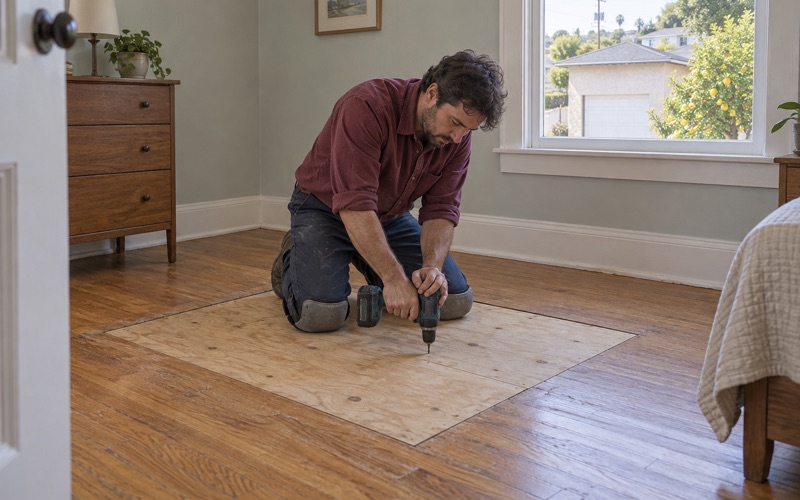
Where a house has a raised foundation and a crawl space, we look at the floor from below before quoting. A sagging floor, a soft spot near a bathroom, or a run of squeaks down a hallway can come from a cracked floor joist, a settled post, or a subfloor that has been wet. A sister joist or new blocking fixes the cause, while sanding only resurfaces the symptom.
The same trip lets us check for drywood termite evidence. Small round kick-out holes and little piles of termite frass along a baseboard are worth identifying before any board is pulled, because replacing wood that is still being eaten wastes the repair. If the holes turn out to have another cause, we say so plainly and move on to the board replacement itself.
Looking for wood-flooring closer to East San Gabriel? See East San Gabriel Wood-Flooring.
What Decades of Sanding Leave on a 1940s Floor
Measuring the wood that remains
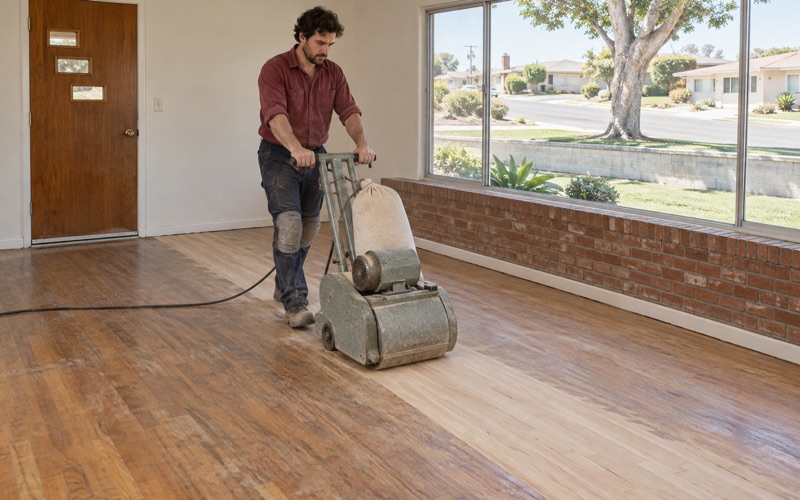
Every full sanding removes wood above the tongue, and a floor laid in the 1940s may have been under a drum sander several times by now, some of them run hard by crews in a hurry. We pull a floor register or a threshold where we can and read the edge of a board to see how much remains before we commit to a full sand.
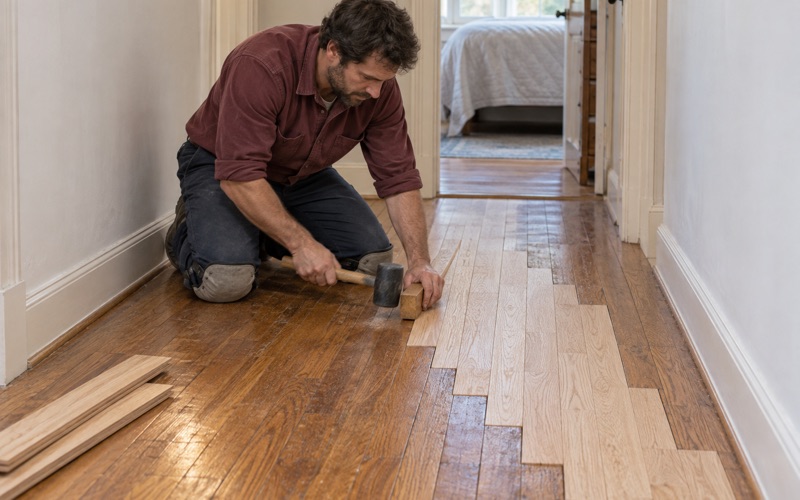
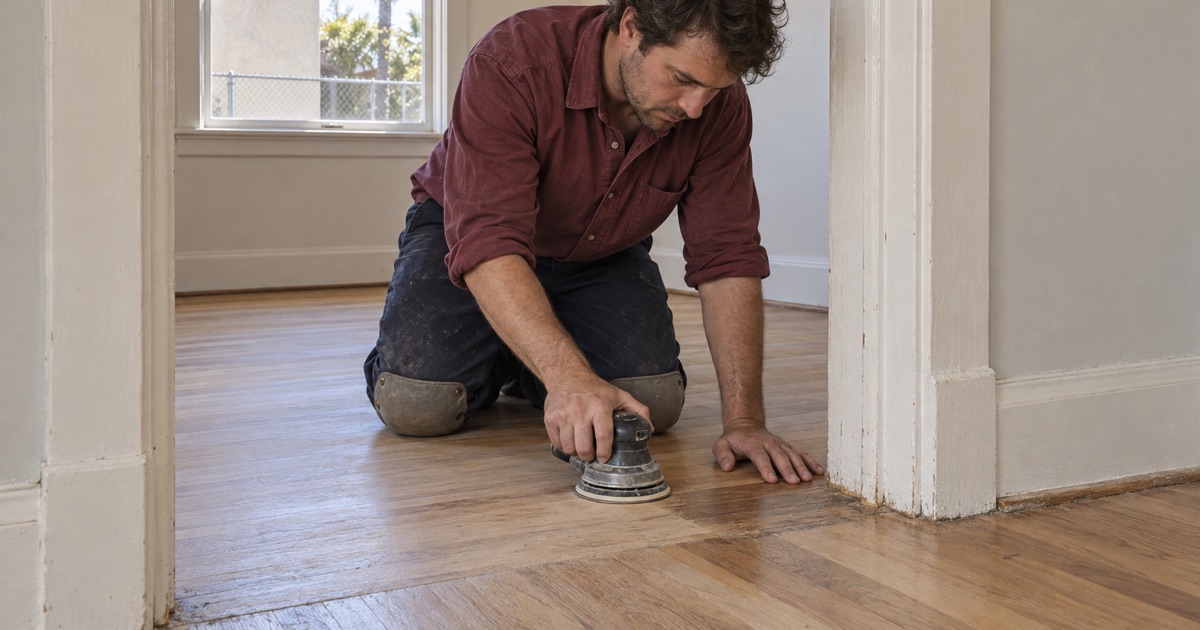
When the margin is thin, the plan changes. A screen and recoat can refresh a sound finish without cutting into the wood, and a weave-in repair can replace boards that were sanded through near doorways. Chatter marks and drum marks left by past jobs can often be cleaned up with a careful abrasive grit sequence and an orbital sander rather than another aggressive cut.
Old stains, old finishes and the lead rule
Older floors carry their history on the surface: pet urine stains gone dark, a black water stain under a window, white haze from wax layered over a finish, and traffic lanes where the finish has worn through to bare wood. Some marks lift with sanding. Black water and deep urine stains usually do not, so we quote those boards for replacement instead of promising they will vanish.
Because 82.6 percent of Bell’s units predate 1980, we confirm the build year before any sanding is scheduled. The EPA Renovation, Repair and Painting Rule governs renovation that disturbs paint in pre-1978 housing, and old floors often meet painted baseboards, shoe molding and stair stringers. Knowing the year first decides how the room is set up and protected before the sander starts.
Finishes and stain color
We choose finishes from products that are legal to apply under the South Coast air district’s rules, where the wood coatings VOC limit under SCAQMD Rule 1113 is 275 grams per liter, rather than from a national catalog. Most owners choose between a waterborne polyurethane, which stays clear and cures faster, and an oil-modified polyurethane, which ambers with age and suits the warm tone of older oak.
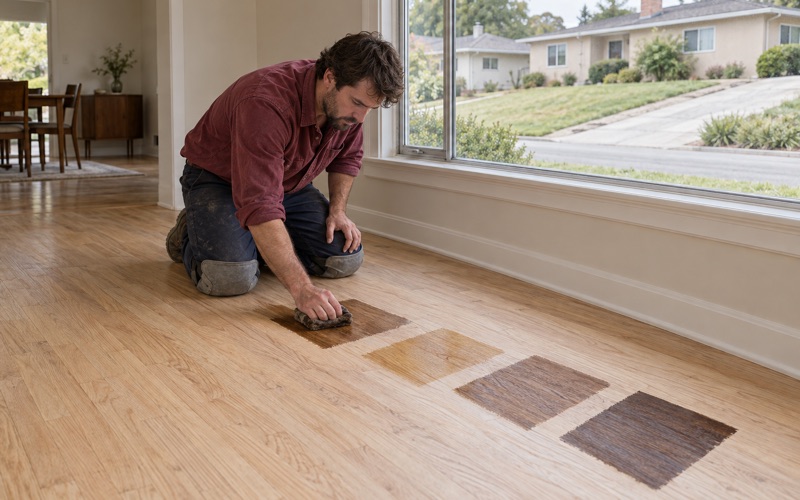
If you want color, we sand a few boards in the room itself and lay out stain sample boards in that room’s own light. Old red oak can pull a gray stain toward pink, and a shaded living room reads darker than a chip in a store. Water popping before staining helps even out color on boards that have been sanded many times over the years.
Owner-Occupied Mobile Homes in Bell
A different job, assessed unit by unit
Only 26.5 percent of Bell’s occupied homes are owner-occupied, about 2,427 households by the ACS estimate. Of those owners, 365 households, 15.0 percent, live in a mobile home. That is a real share of the people in Bell who might hire us, and we want to be plain with them: a mobile home is a different job from a 1940s house, and we assess each unit on its own.
We do not quote a mobile home floor from a phone call or a photo, and we do not assume what one unit’s floor can carry because of what we saw in another. Construction varies by maker and year, and earlier owners have made their own changes. Before we suggest engineered hardwood, a floating floor or luxury vinyl plank, we look at the unit in person.
What that visit covers
On a mobile home visit we check for soft spots, sloping and squeaks, look at how the existing flooring is fastened, and measure heights at doors and transitions, where a thicker new floor can cause trouble at a reducer or T-molding. We also take moisture meter readings. Those findings, not a general rule about mobile homes, decide what we recommend for that particular unit.
If you live in a park, you know the approvals that apply to your space better than we do, and we ask you to confirm them before work is booked. Our part is a written scope for that unit, a named product, and a schedule showing which rooms will be out of use, for how long, and when furniture can go back.
Rented Houses in Bell and the Owner Who Orders the Work
Tenant-occupied detached houses
Renters make up 73.5 percent of Bell’s households, and many of them live in detached houses: 2,531 renter households, 37.5 percent of renters. By comparison, 1,876 owner households, 77.3 percent of Bell’s owners, live in detached houses themselves. So a good number of the floors we refinish here belong to someone who does not live on them, and the call often comes between tenants.
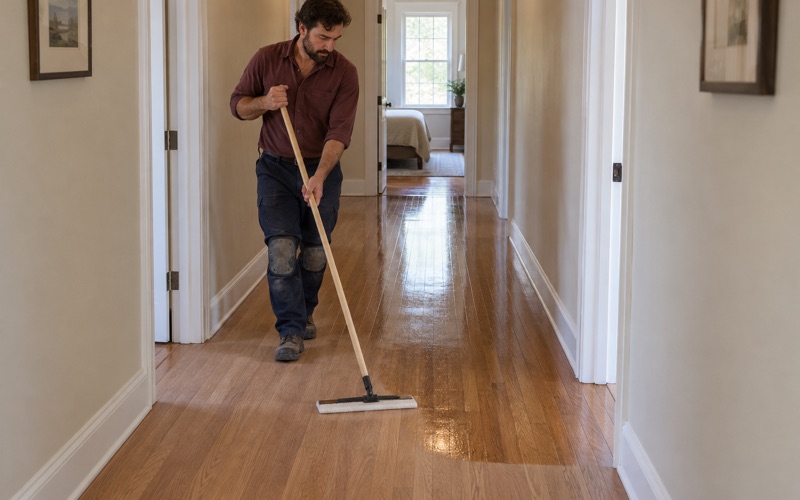
Turnover work runs on a short clock. We schedule sanding, finish coats and cure time room by room so the owner knows when the house can be shown and when a new tenant can bring furniture in. A screen and recoat is often the right answer between tenancies, saving a full sand for the year the finish is truly worn through.
Invoices and records a landlord can use
Our invoices are itemized by room and by task, so a landlord can attach them to a security deposit itemized statement without rewriting them. Replacing boards ruined by a pet urine stain is listed separately from ordinary refinishing, and wear from normal living is not blended into damage. That separation is what makes the paperwork useful if a deduction is ever questioned.
When a floor has a water loss, we document it with photos and moisture readings an adjuster can use, and we write the repair scope as matching board and finish rather than a patch. For an owner living in the house, those records support an insurance claim. For a landlord, they also show exactly what was done, in which room, and when.
Selling a house in Bell
Owners preparing to sell sometimes call us in the same weeks they order the Real Property Presale Report that Bell has required since Ordinance 1173 was adopted in September 2008. That report looks at permit history, code compliance and nonconforming structures. We make no claim that it looks at floors; a refinish is simply work sellers often schedule in the same window before listing.
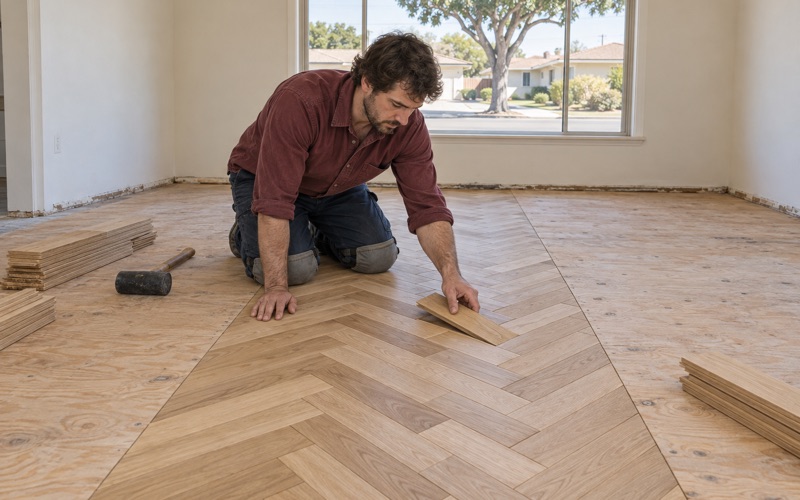
Bell covers about 2.5 square miles on the west bank of the Los Angeles River, incorporated on November 7, 1927, and it has no historic preservation ordinance. For a seller or a long-time owner, that leaves replacement boards, refinishing and new layouts to the owner’s judgment, and when a herringbone or chevron is chosen we dry-lay it on the room’s centerline before the first slat is fastened.
- 20+ Years on Wood Floors
- Itemized Written Quotes
- Lead-Safe Checks on Pre-1978 Homes