Monterey Park Wood Flooring handles wood flooring in Boyle Heights the way more than twenty years in this trade has taught us to: by assuming the floor underfoot is old until the house proves otherwise. We sand, repair, refinish and install solid and engineered hardwood, and on this side of the river most of our work starts with boards that have already been sanded, patched or covered at least once.
That history shapes every quote we write. Before we schedule a drum sander, we confirm the year the building went up, because paint and finish layers in pre-1978 housing are handled under the federal lead-safe renovation rule rather than swept up with a shop vacuum. Before we promise a full sand on an engineered floor, we measure its wear layer so the promise is one the floor can keep.
What follows explains what an older floor here usually needs, how we approach the houses, courts and small buildings that make up the neighborhood, and which City of Los Angeles programs owners mention when they call us. None of it replaces a visit to your home, but it should make that visit shorter and the estimate easier to read.
A Neighborhood Finished Before 1940
What the census proxy shows
Boyle Heights has no Census place of its own, so we read the ZIP 90033 Census area as a labeled proxy for it. In the American Community Survey 2024 five-year estimates, 38.1 percent of the housing units in that ZIP were built in 1939 or earlier. The proxy is not the neighborhood boundary, but it is the cleanest single area that covers most of it.
The more telling number is what came after. No later decade in that ZIP accounts for more than 10.8 percent of the stock, and the largest of them, the 1950s, reaches only that share. There was no big postwar wave that replaced the older buildings, so an aged floor is simply the ordinary floor here rather than the exception we plan around.
Old floors on the bluffs east of the river
The neighborhood takes its name from Andrew Boyle, who bought 22 acres on the bluffs east of the Los Angeles River and built his home there in 1858. William Workman later built early infrastructure, and the area grew into a center of Jewish, Mexican and Japanese immigrant life from the 1920s through the 1960s, long before most of its floors saw their latest finish.
For us, that long settled history shows up in the boards themselves. Many floors we open here have been refinished several times, and each sanding took some wood off the top of the tongue. Before we plan another full sand, we check how much remains at a floor vent or threshold, because a sand-through on solid hardwood means board replacement rather than a quick touch-up.
What decades of wear do to a wood floor
The problems we see most often are the ones time produces: seasonal gapping between narrow strips, squeaks where old nails have loosened, hollow spots, worn-through finish along walkways, and black water stains beside sinks and exterior doors. Pet urine stains that have soaked below the finish are common too, and they rarely sand out no matter how many passes we make.
We sort these into what a sand and finish can fix and what needs a weave-in repair first. Gaps and squeaks often come down to the fastening or the subfloor, while a gray or black stain usually means the wood itself is damaged. Our quote lists each item separately, so you can see which part of the price is repair and which part is refinishing.
Looking for wood-flooring closer to South Pasadena? See South Pasadena Wood-Flooring.
Houses, Courts and Small Buildings of the Same Era
Single-family houses and the floor underneath
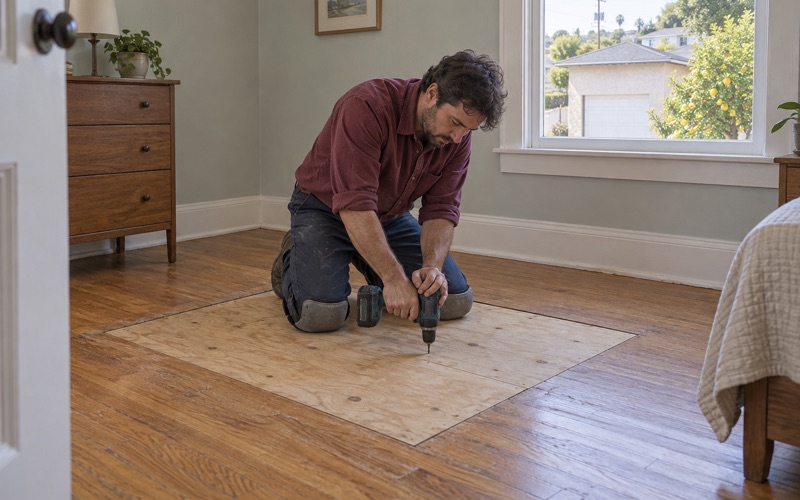
Where a Boyle Heights house sits on a raised foundation, we go into the crawl space before we price the job. A sloping floor, a sagging floor or a soft spot near a doorway is often a floor joist, post or board subfloor problem, and sanding the surface would only put a fresh finish on a floor that still moves when you walk on it.
If a joist has cracked or been notched for old plumbing, we walk you through the options, such as a sister joist, before any refinishing is scheduled. On a slab-on-grade house the approach changes entirely: we take moisture meter readings on the concrete and discuss a vapor retarder and glue-down installation or a floating floor rather than nailing into a surface that cannot hold a cleat.
Courts and rows of similar units
Courts are part of the neighborhood’s texture, from well-known complexes such as Estrada Courts and Aliso Village to smaller groups of units sharing a walkway. In the ZIP 90033 proxy, attached single-family units number 1,775 alongside 3,776 detached ones, so a job here is often one unit in a row of floors that were laid the same way at the same time.
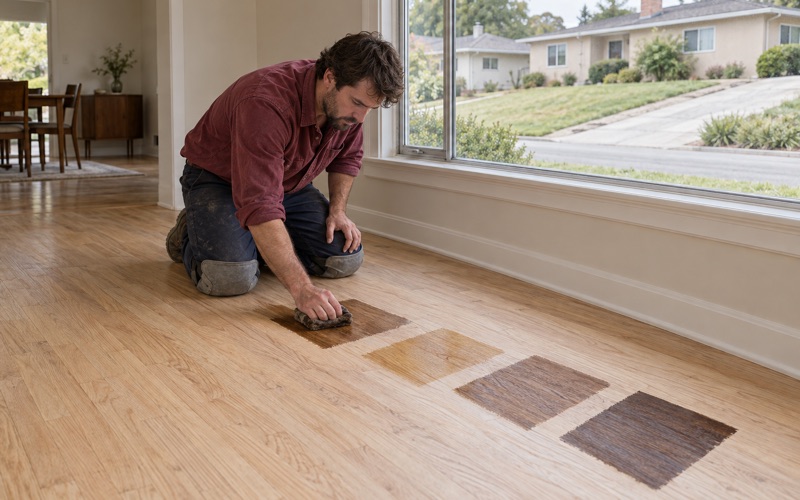
That matters most when we match wood and color. When one unit’s floor is repaired or refinished, the owner usually wants it to read like its neighbors, so we lay out stain sample boards on sanded wood in the room’s own light and compare sheen levels before the full floor is committed. It is slower on the first day and saves a redo later.
Two-to-four-unit buildings and small apartments
Small multifamily buildings are the third common setting we work in. Many owners here are landlords with a unit between tenants and a short window to turn it, so we write a room-by-room schedule showing when the floor can take furniture again and when the cure time allows ordinary traffic and rugs to return.
Our invoices are itemized so an owner can attach them to a security deposit itemized statement, separating ordinary wear on an older floor from damage like a pet urine stain or a deep gouge. On upper floors we also talk through acoustic underlayment for any floating floor, though we never quote sound-rating figures; your building or association rules govern that decision.
City of Los Angeles Programs Near Older Buildings
Who has jurisdiction here
Boyle Heights is a neighborhood and community plan area inside the City of Los Angeles, not a separate municipality, so the Los Angeles Department of Building and Safety, known as LADBS, is the office that issues building permits here. When a project reaches beyond the floor surface into framing or structure, that is the office an owner should contact directly.
We do not give permit answers for floor work of any kind. Whether a particular project needs one is a question for LADBS, and we would rather you hear it from the city than from a flooring crew. What we can do is describe the scope clearly in writing, so any conversation with the city starts from accurate facts about the job.
Soft-story retrofits and your floors
Some owners of larger wood-frame buildings have heard of the city’s Soft-Story Retrofit Program, run by LADBS under Ordinances 183893 and 184081. It covers wood-frame buildings of two or more stories built under codes enacted before January 1, 1978, with ground-floor parking or similar open space, and it does not apply to residential buildings of three or fewer units.
We treat that program as background only. It is a structural program, and we do not present it as a reason to replace or refinish a floor. If your building is scheduled for retrofit work, we simply coordinate timing with you so new wood is not sanded and finished while other crews are still working in the space around it.
Rent stabilization and older rentals
Many rentals here may also fall under the city’s Rent Stabilization Ordinance, administered by the Los Angeles Housing Department. Published summaries describe it as covering rental properties of two or more units that received a certificate of occupancy on or before October 1, 1978. We mention it only because owners ask, and questions about it belong with the department.
For our part, the paperwork stays the same either way. Whether or not a unit is covered, the invoice we write describes the work, the materials and the rooms, and the photos we take before and after document the floor’s condition in a form an owner can keep on file for as long as they need it.
Wood Floor Services Across Boyle Heights
Refinishing, screening and finish choices
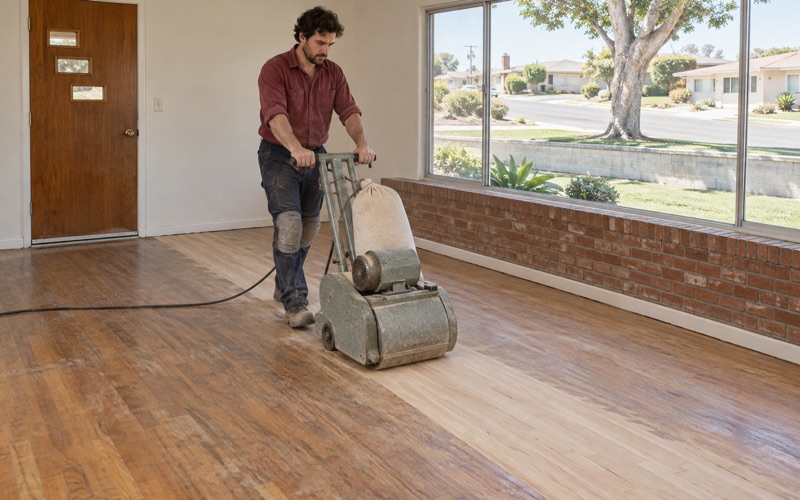
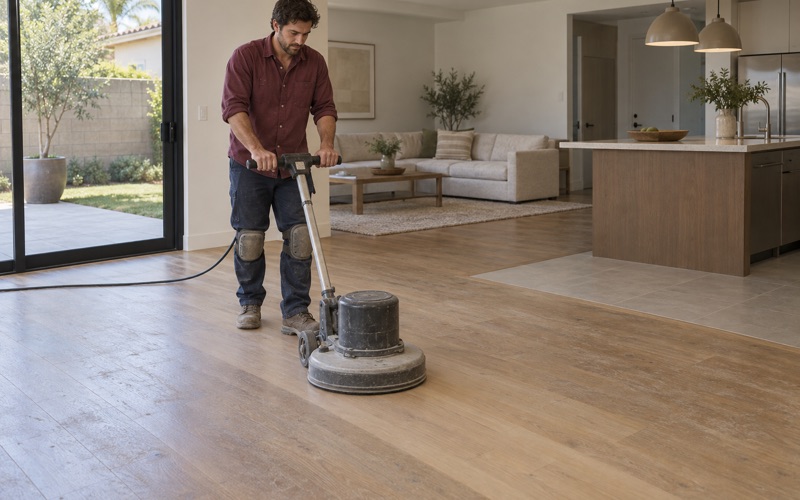
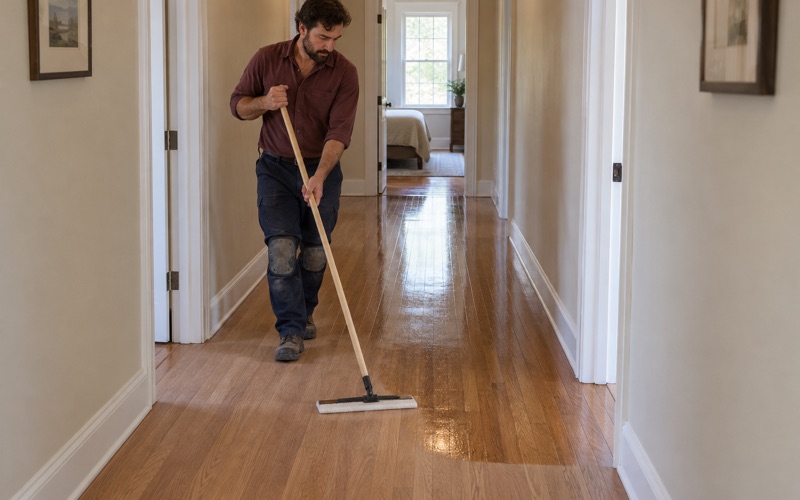
Refinishing is most of what we do here. We move through an abrasive grit sequence with a drum sander, edger and orbital sander, watching for chatter marks and drum marks on older, softer boards, and we use dustless sanding in occupied homes. Where the finish is only dull or lightly scratched, a screen and recoat may be all the floor needs.
Finishes come from products legal to apply in the South Coast air district, where the wood coatings limit is 275 grams per liter, so the choice is between compliant waterborne polyurethane, oil-modified polyurethane and hardwax oil rather than anything a national catalog happens to list. We explain how each one affects color, cure time and the recoat window.
Repairs, termite checks and water damage
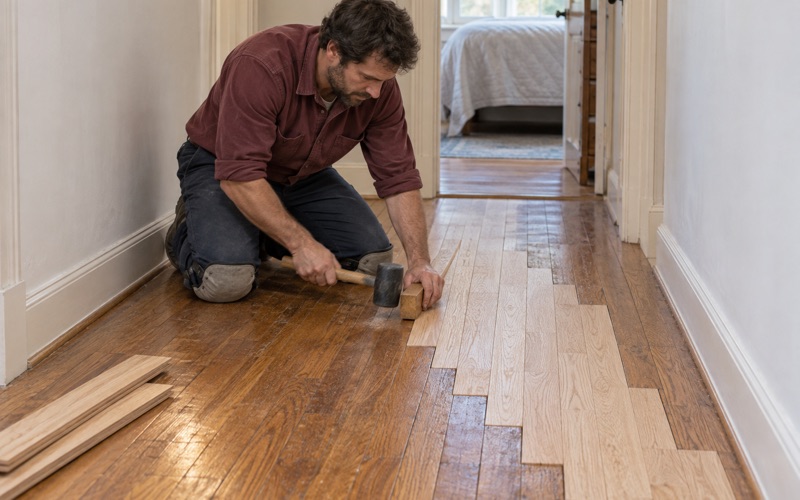
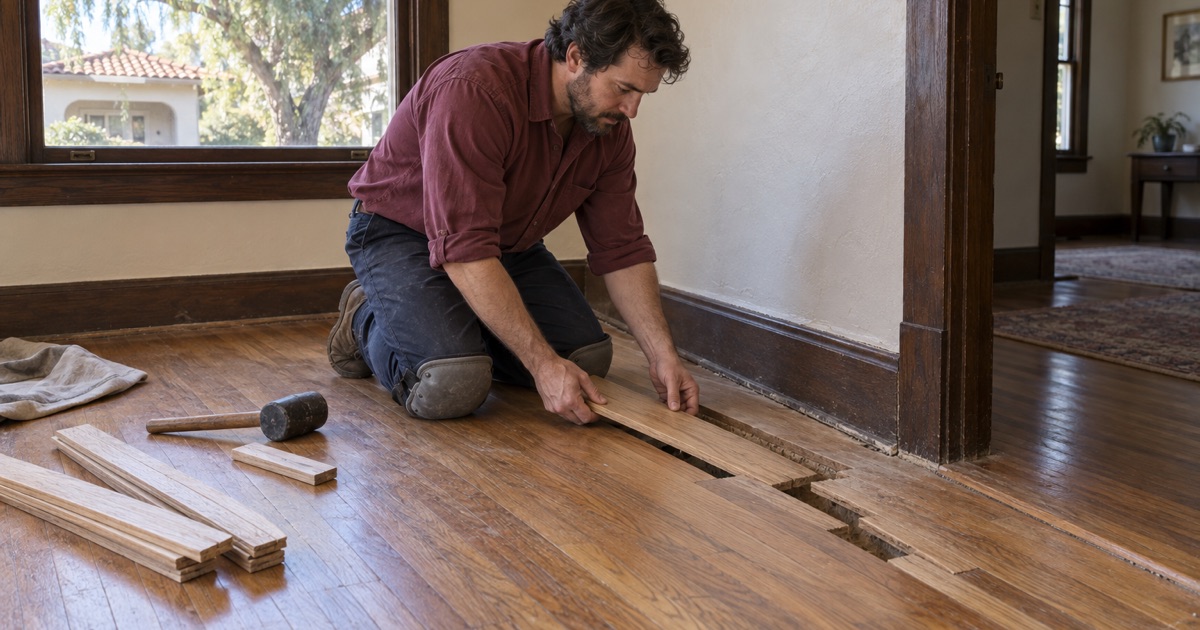
Board replacement on an old strip floor starts with finding matching red oak or white oak of the right width and weaving it in so the repair disappears after finishing. Before we pull any board with small round holes or a pile of pellets beneath it, we confirm or rule out drywood termite activity, since kick-out holes and termite frass point to a different problem.
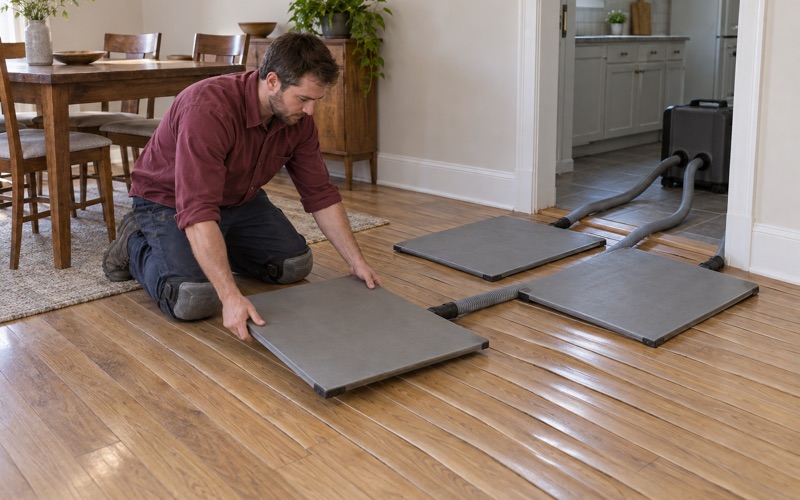
After a leak, we document the loss with photos and moisture readings an adjuster can use, and we write the repair scope as matching board and finish rather than a patch. Cupping or crowning after a water event often settles once the wood dries, so we measure the moisture before recommending any replacement at all.
New floors, stairs and patterned layouts
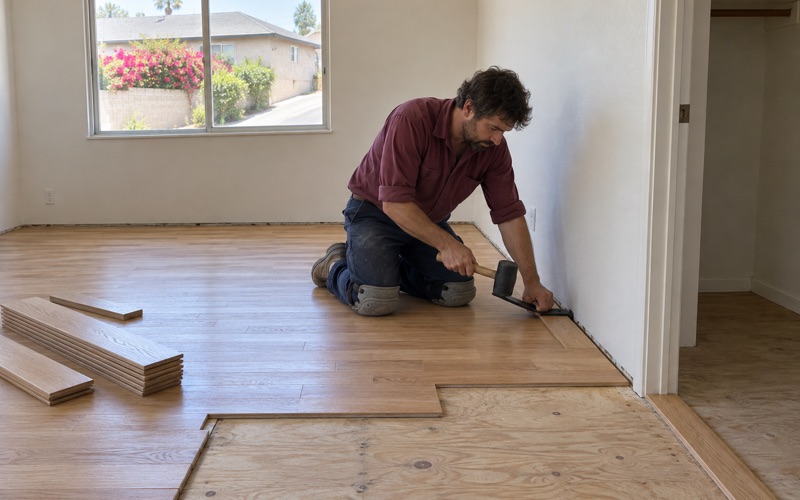
When a floor is past saving, we install solid hardwood or engineered hardwood by nail-down or glue-down installation, depending on the subfloor. On engineered products we explain wear layer thickness up front, because it decides how many future sandings the floor can take, and we leave the expansion gap the product requires at every wall.
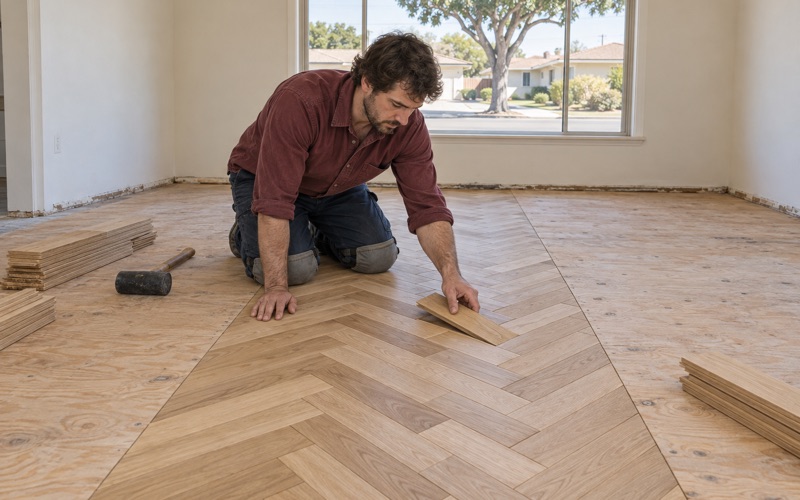
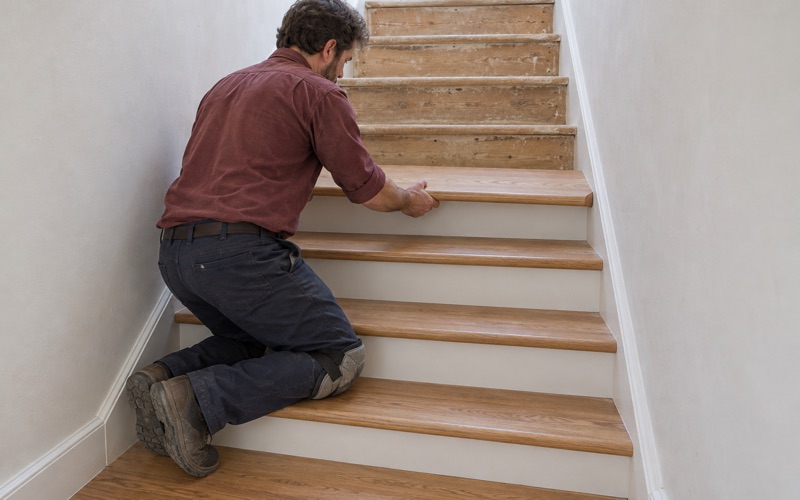
Stairs are priced by the tread, riser and stair nosing rather than folded into a square-foot figure, which keeps a staircase quote honest in older houses with worn or uneven steps. For herringbone or chevron, we dry-lay the pattern and center it on the room’s layout centerline before the first slat is fastened, so the design lines up with the doorway you see first.
- 20+ Years on Wood Floors
- Itemized Written Quotes
- Lead-Safe Checks on Pre-1978 Homes