
Monterey Park Wood Flooring provides hardwood floor recoating in Monterey Park, CA, using more than 20 years of hardwood experience to tell when a floor needs only a fresh coat of finish and when it needs more. A recoat, often called a screen and recoat, abrades the top of the existing finish and adds new coats, restoring sheen and protection without sanding to bare wood.
It is the least disruptive way to renew a hardwood floor. There is far less dust than a full sanding, the work usually takes a day or two, and it removes none of the wood, so it extends the life of the floor. Done on a regular schedule, recoating can put off a full refinish for many years.
The catch is adhesion. A new coat only holds if the old finish is clean and properly abraded, and if the two products are compatible. We test adhesion before recoating any floor, because a recoat that peels a month later costs more to fix than the recoat itself.
When a Recoat Is the Right Choice
Signs Your Floor Needs a Recoat
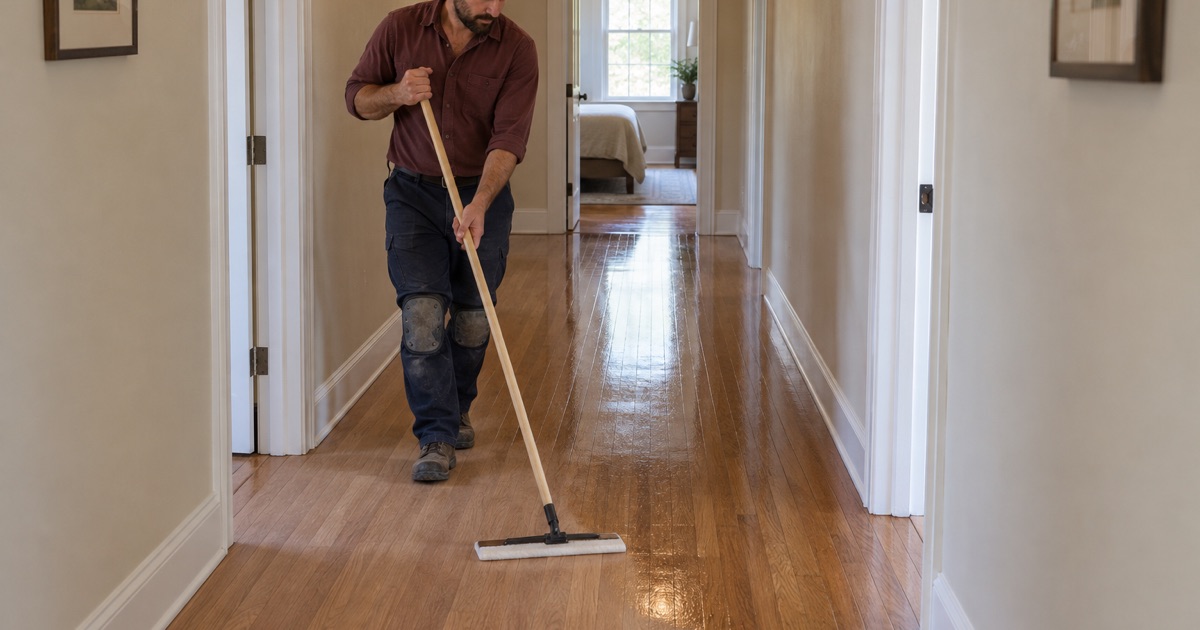
A floor that looks dull in the traffic lanes, has fine surface scratches, or has lost its sheen near doorways and in front of the sink is a good recoat candidate, as long as the finish is still intact. If the color of the wood under the scratches looks the same as the rest of the floor, the finish is doing its job and can simply be renewed.
Recoating at this stage protects the wood before wear reaches it. Waiting until the finish wears through turns a simple recoat into a full sanding and refinish.
When a Recoat Is Not Enough
Gray, bare wood in the traffic lanes means the finish has worn through, and new finish over bare wood will look different from the areas around it. Deep scratches, gouges, pet stains and water marks that have reached the wood also remain visible under a new coat.
In those cases we recommend a full refinish or a combination of board replacement and recoating. We show you what a recoat would and would not change before you decide.
Preparing a Floor for Recoating
Cleaning Off Polish and Residue
Many floors carry years of polish, acrylic floor restorers, wax or oil soap. New finish will not bond to any of them, and they are the leading cause of recoats that peel. We identify what has been used on the floor and remove it with the right cleaner before any abrasion.
Where a floor has been waxed, a recoat is generally not possible without sanding, because wax soaks into the finish and the wood. We test for wax first and tell you if the floor needs a full refinish instead.
Screening and Abrading the Existing Finish
Screening uses a buffer fitted with a fine abrasive screen or pad to scuff the whole surface evenly. The goal is to dull the existing finish uniformly so the new coat can grip it, without cutting through to the wood.
Edges and corners are hand-abraded, and the floor is then vacuumed and tacked to remove every trace of dust before finish is applied. Any dust left behind is sealed into the new coat as small bumps, which is why the cleanup takes nearly as long as the screening itself.
Testing Adhesion Before the Whole Floor
We apply the chosen finish to a small, out-of-the-way area and test it once it has dried, scoring it and checking whether it lifts. If it holds, we recoat the floor. If not, we adjust the cleaning, the abrasion, or the product, and test again.
This small step prevents most recoat failures. It is also the one most often skipped by crews quoting the lowest price.
Recoating Different Types of Floors
Site-Finished Solid Hardwood
Solid hardwood floors finished on site with polyurethane are generally the easiest to recoat. We confirm whether the existing finish is waterborne or oil-modified and choose a compatible product, since some combinations bond poorly without a bonding agent.
Recoating an older oil-modified floor with a waterborne finish can also change the color slightly, lightening the amber tone over time. We show you that difference on the test area before recoating the whole floor.
Prefinished and Engineered Floors
Prefinished floors, both solid and engineered, often have very hard factory finishes that resist bonding. They need thorough abrasion and sometimes a bonding primer, and their beveled edges must be carefully hand-abraded so the new finish does not pool.
On engineered floors with thin wear layers, a recoat is often the only renewal option available, since a full sanding could reach the core. Recoating them regularly protects that limited layer of real wood.
Recoat Finishes and Cure Time
Choosing the Finish and Sheen
We usually recoat with a commercial-grade waterborne polyurethane, which dries clear, has low odor and allows faster return to use. Oil-modified finishes are available where they match the existing floor. Sheen can be matched to the original or changed, since satin and matte hide wear better than gloss.
All recoat finishes are chosen from products legal to apply in the South Coast air district, so the finish meets local air rules. That matters more on a recoat than people expect, because the new coat has to be compatible with the finish already on the floor, and a product brought in from outside the district may be both noncompliant and a poor match for what is there.
Getting Back on the Floor
Most recoats allow light foot traffic in socks within a day, but full cure takes longer. We give you written dates for when furniture with felt pads can return and when rugs can go back down, based on the product’s data sheet, so the fresh finish is not marked before it has hardened.
- 20+ Years on Wood Floors
- Itemized Written Quotes
- Lead-Safe Checks on Pre-1978 Homes