Monterey Park Wood Flooring has spent more than 20 years on wood flooring, and our wood flooring in Lomita work starts with a question most crews skip: what kind of home is this floor actually sitting in? The answer decides whether we are sanding solid oak, measuring the wear layer on an engineered plank, or confirming a floor system before recommending any product at all.
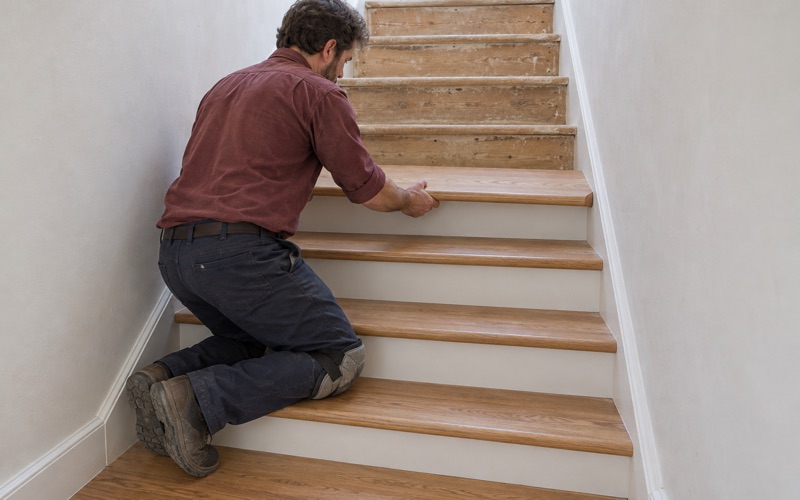
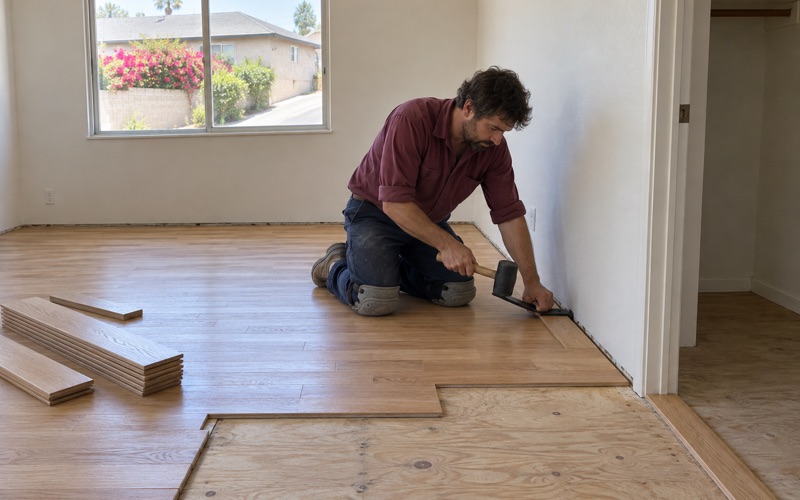
We refinish worn hardwood, repair cupped, buckled and water-stained boards, install new solid and engineered floors, and rebuild stairs tread by tread. Every job begins with a look at the room, the boards and what lies beneath them, because a finish applied over an unanswered problem tends to fail within a season or two.
What follows is how we approach floors across the housing you actually find here, from single-family houses of several different decades to the mobile and manufactured homes that make up a real share of local addresses. If you already know what you need, the sections below explain what we check first and why it matters for your floor.
A City of Houses Rather Than High-Rises
Why Lomita’s Housing Looks the Way It Does
Lomita incorporated on June 30, 1964, in part to curtail high-rise apartment development, and also to prevent further annexation by neighboring cities. Six decades later the housing still reflects that choice. According to the American Community Survey 2024 five-year estimates, 50.2 percent of Lomita’s housing units are one-unit detached houses, 3,965 of 7,904 units in all.
That matters to a flooring contractor more than it might seem. A detached house has its own floor system, its own history of repairs and its own owner deciding what gets done. We are rarely working around a building manager or a shared assembly, and much more often talking directly with the person who will live on the finished floor for the next twenty years.
The Second Layer: Mobile Homes
The same survey counts 544 mobile homes in Lomita, 6.9 percent of all housing units, and 254 owner households live in one. Another 185 renter households live in mobile homes as well. For a city of under two square miles, that is a meaningful number of floors that do not fit the usual hardwood playbook.
So this page covers both kinds of home. A site-built house and a manufactured home can look similar from the living room, but the questions we ask before recommending a floor are different, and we would rather ask them on the first visit than discover the answer halfway through an installation.
Looking for wood-flooring closer to Palos Verdes Estates? See Wood-Flooring Services in Palos Verdes Estates.
Detached Houses Across Lomita
Several Decades of Construction
Lomita’s housing was not built in a single wave. The 1950s, 1960s and 1970s each account for about a fifth of the housing units, and 10.1 percent of the stock predates 1940. In practice that means one street can hold original strip oak under carpet, a later remodel’s engineered plank, and a floor that has been sanded so many times its tongues are showing.
Because of that range, we never assume what a floor is from its age alone. We pull a floor vent or a threshold where we can, check board thickness, and look for old nail patterns and earlier repairs. That tells us whether a full sand is realistic or whether a screen and recoat is the honest recommendation.
Looking Underneath Before We Quote
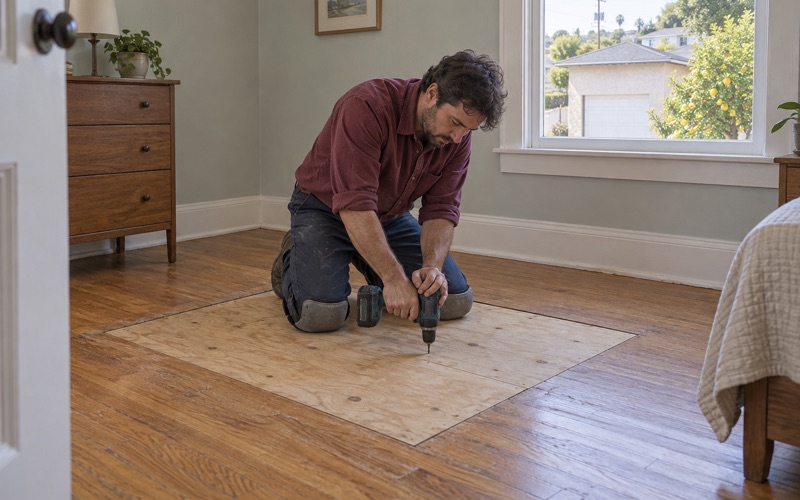
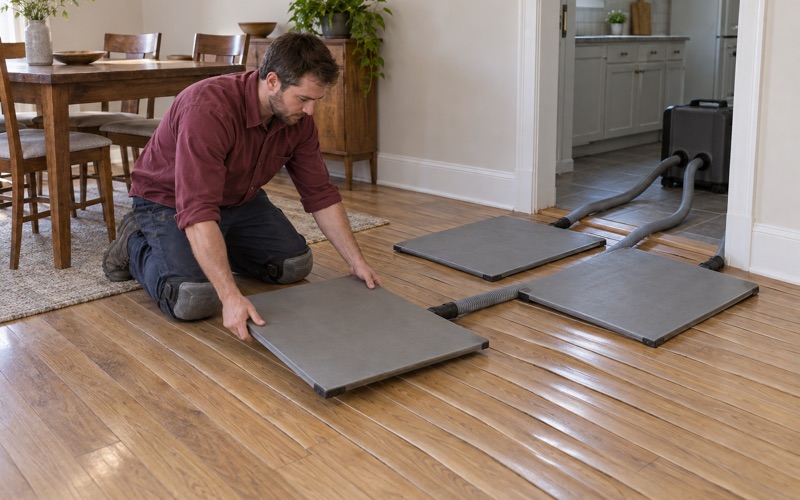
Where a house sits over a crawl space, we check the floor from below before we put a price on refinishing it. A sloping floor, a soft spot or a bounce underfoot is often a floor joist, post or subfloor problem, and sanding the surface only hides it for a while. A sister joist or a new post is sometimes the real first step.
We also look for drywood termite evidence while we are down there and across the surface. Small round kick-out holes and little piles of termite frass get identified or ruled out before any board replacement is scheduled, since replacing damaged boards without addressing the cause just invites the same damage back into new wood.
Build Year and Old Finishes
Most of Lomita’s housing predates 1980, so we confirm a home’s build year before any sanding is scheduled. In pre-1978 housing, old paint and finish layers are handled under the EPA Renovation, Repair and Painting Rule, which shapes how we contain dust, clean up and plan the order of the rooms.
Older floors sometimes hide something else under carpet or tile, including black mastic from an earlier covering. When we find it, we stop and talk through the next step rather than grinding through it. That conversation happens before the drum sander comes off the truck, not after dust is already in the air.
Mobile and Manufactured Homes in Lomita
Confirming the Floor System First
With 254 owner households and 185 renter households living in mobile homes here, we get asked regularly whether wood can go into one. Our honest answer is that it depends on the specific home, and we do not guess. We confirm how that particular manufactured home’s floor is built before we choose or recommend any flooring product.
That means looking at what is under the existing covering, checking for soft spots, squeaks and hollow spots, and asking what the owner knows about the home’s history and any prior repairs. If the manufacturer’s documentation is available, we want to see it. A floor that is right for a detached house may simply be the wrong choice here.
Weighing the Options Together
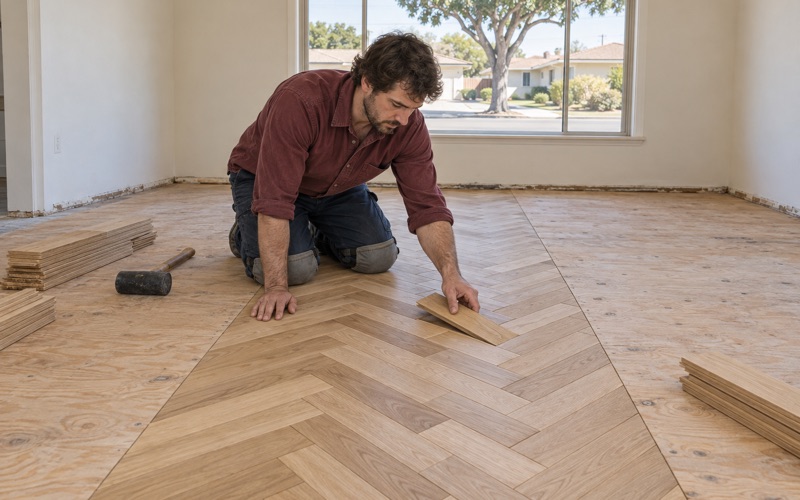
Once we understand the floor system, we walk through the realistic options with you. Engineered hardwood, a floating floor over acoustic underlayment, or luxury vinyl plank each behave differently, and each suits different conditions. We explain the tradeoffs in plain terms and let the floor we found steer the recommendation rather than the other way around.
We also talk about practical details that matter in a smaller home: reducers and T-molding where the floor meets another surface, quarter round at the walls, and an expansion gap that lets a floating floor move with the seasons. Getting those transitions right is what makes a new floor look finished instead of patched in.
Park Rules and Paperwork
Many mobile homes sit in parks with their own rules about contractors, working hours and deliveries. We ask about those rules at the first visit so the schedule works around them. Questions about permits or approvals for a particular home are ones we point you toward the appropriate agency on, rather than answering from memory.
For a landlord renting out a mobile home, we write itemized invoices that can be attached to a security deposit statement. Each line shows the area, the material and the work, so the record of what was repaired and why is clear to both the owner and the tenant.
Refinishing or Replacing Floors in an Older House
Sanding, Recoating or Replacing
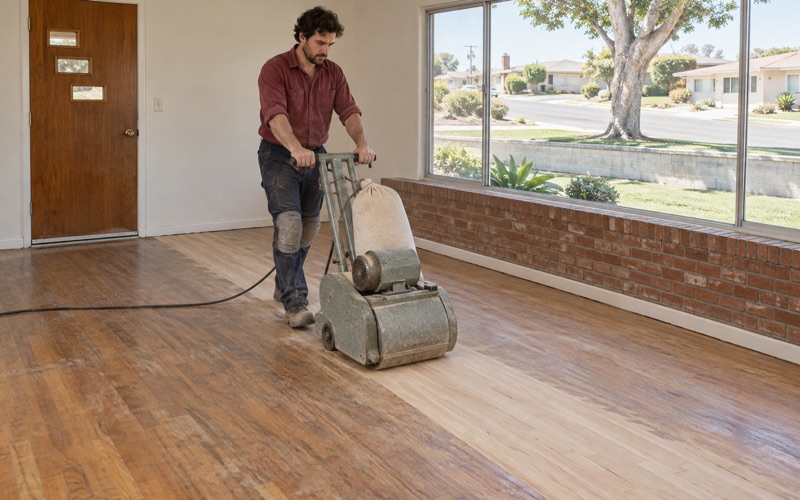
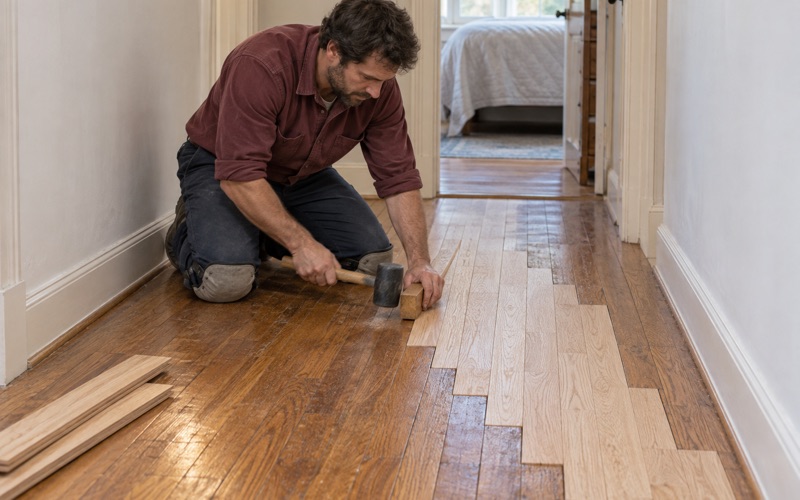
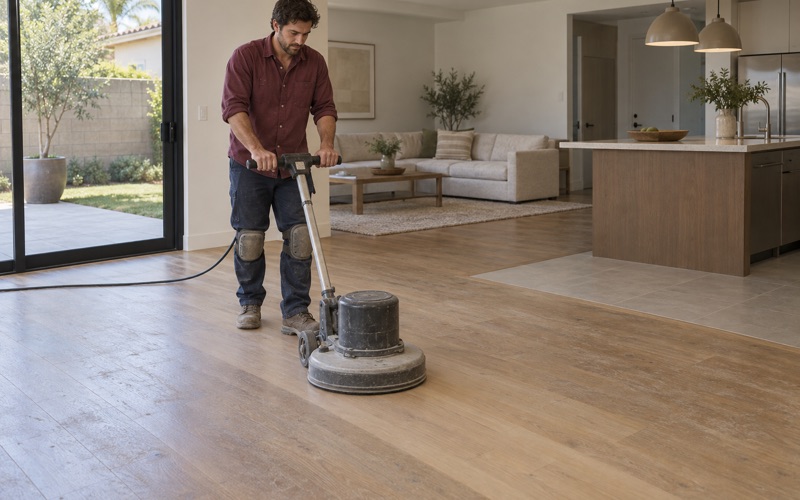
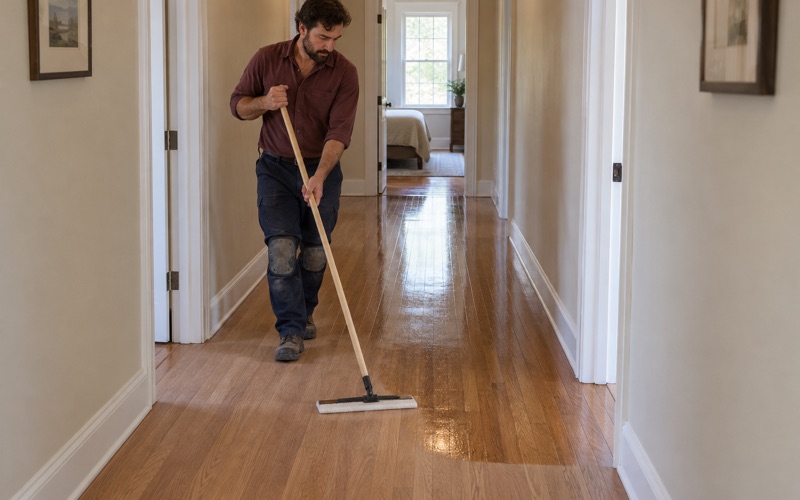
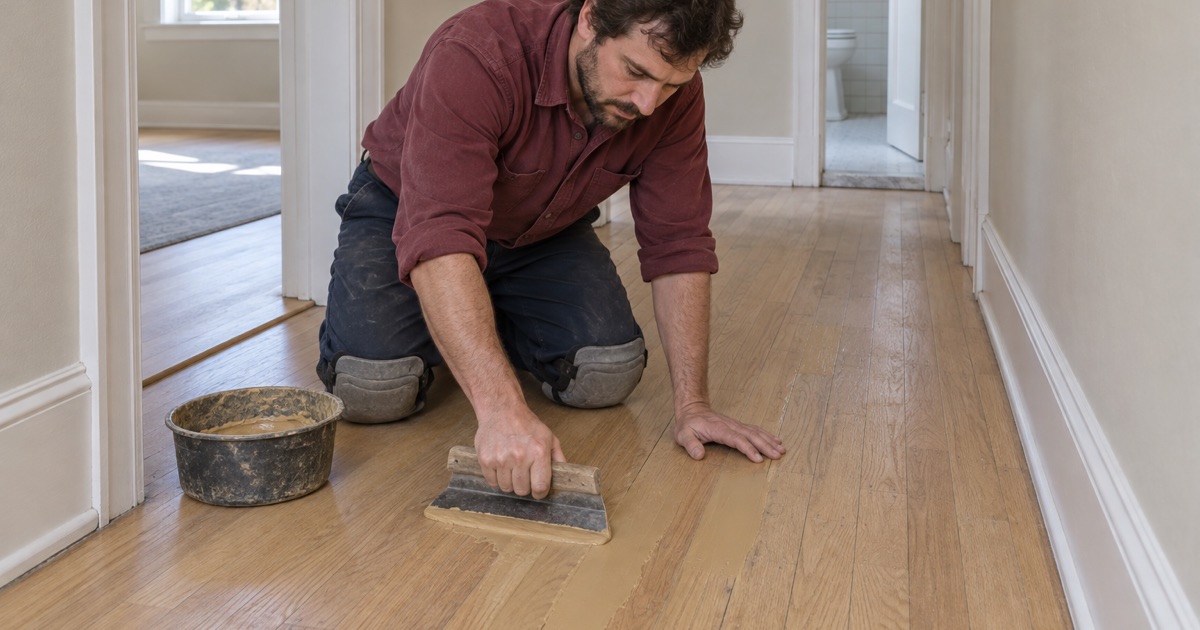
Not every tired floor needs a full sand. If the finish is worn but the wood beneath is sound, a screen and recoat can restore it in far less time. When the finish is worn through, gray, peeling or showing pet urine stains and black water stains, a full sand with a proper abrasive grit sequence is usually the answer, followed by board replacement or a weave-in repair where stains go too deep.
On engineered floors, we measure wear layer thickness before promising anything. A thin veneer can take a screen and recoat but not a full sand, and a sand-through is not something any finish can hide. Knowing that number up front keeps the quote honest and spares you a floor that has to be replaced after it was supposed to be refinished.
Stain, Finish and Air Rules
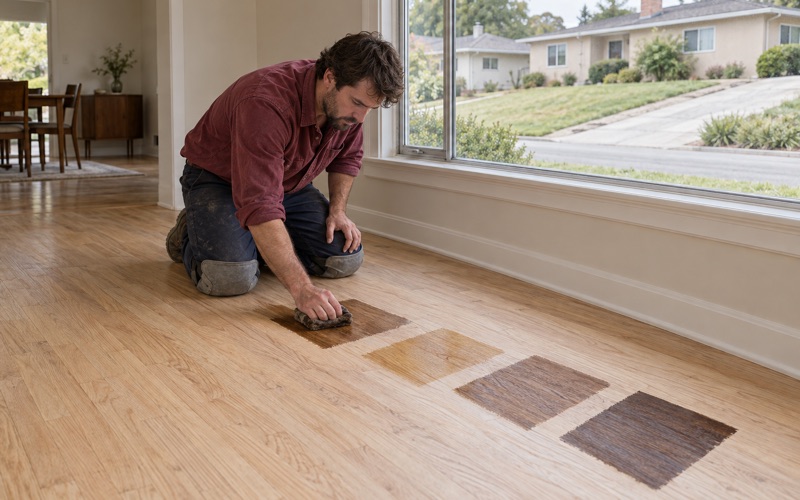
We test stain color on sanded sample boards in your own room’s light before the whole floor is committed. Red oak and white oak take the same stain very differently, and a color that looked right in a showroom can read far warmer or grayer under Lomita afternoon sun coming through a west window.
Finishes are chosen from products legal to apply in the South Coast air district, where SCAQMD Rule 1113 sets the wood coatings limit at 275 grams per liter. That shapes whether we use a waterborne polyurethane, an oil-modified polyurethane or a hardwax oil, and it keeps us working from a regional product list rather than a national catalog.
Planning Around an Occupied Home
Most of our Lomita clients stay in their homes while we work, so we give you a written room-by-room schedule. It shows when each area is sanded and coated, how long the cure time runs, and when furniture, rugs and family can come back. That lets you plan meals, pets and sleep around the floor rather than around guesswork.
If the job starts with water damage, we document the loss with photos and moisture meter readings an adjuster can use. The repair scope is written as matching board and finish rather than a patch, so the finished floor reads as one surface. From the first look underneath to the final coat, we would rather answer the hard questions early than leave you with a floor that only looks fixed.
- 20+ Years on Wood Floors
- Itemized Written Quotes
- Lead-Safe Checks on Pre-1978 Homes