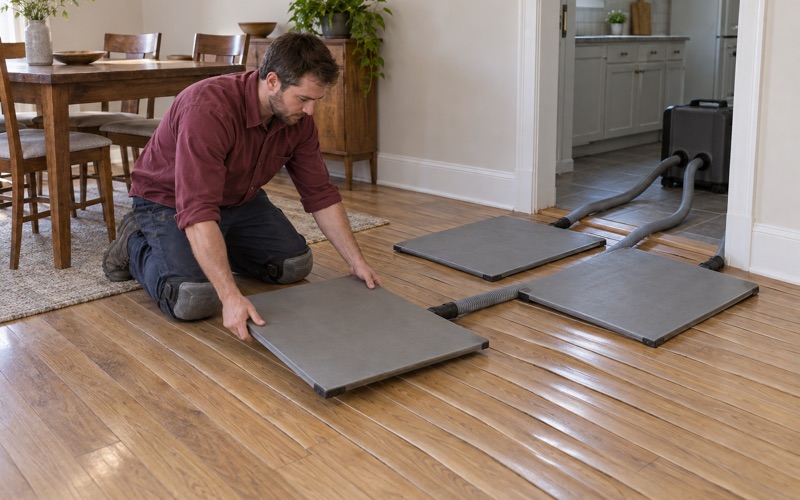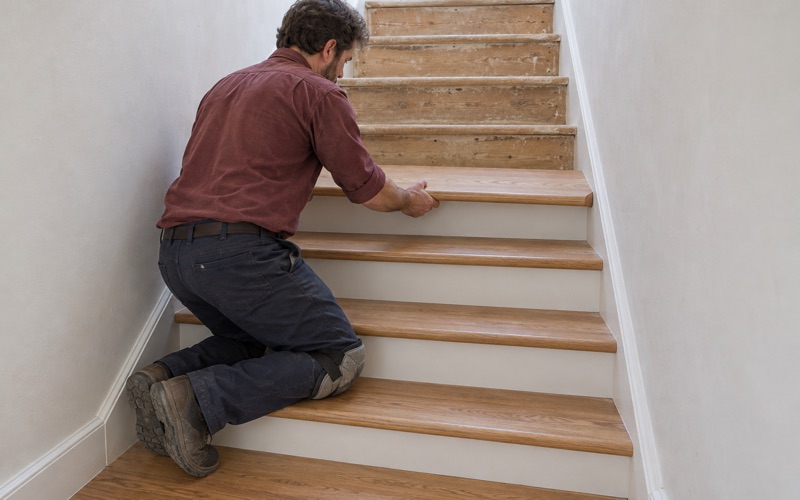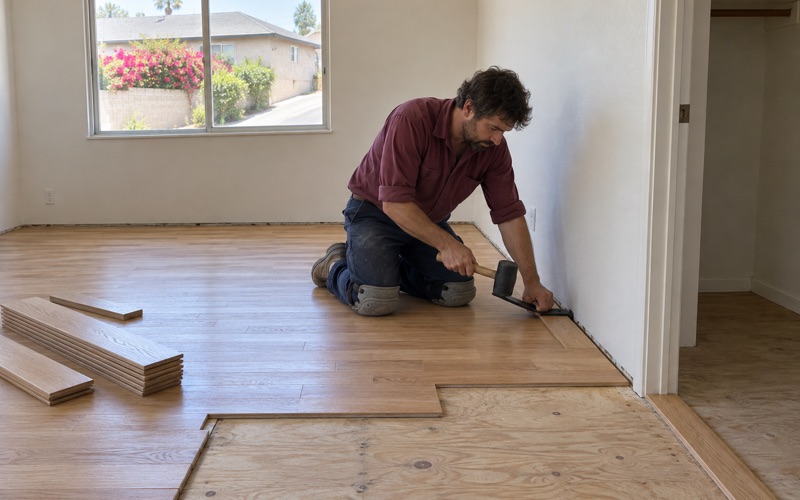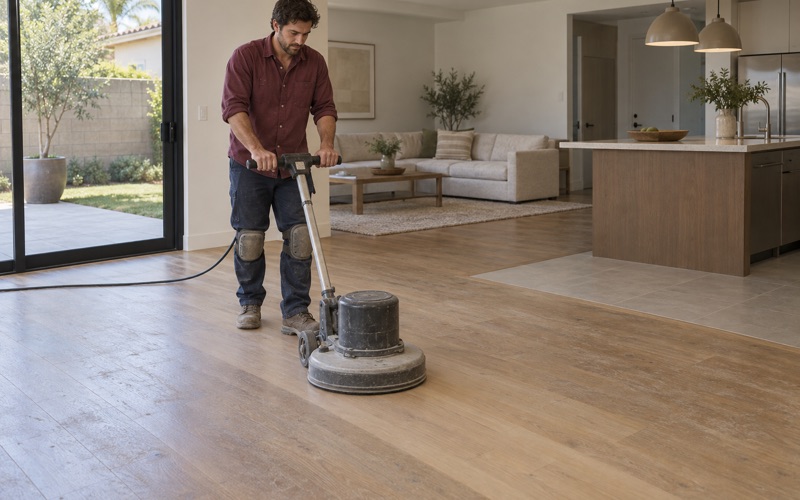
Monterey Park Wood Flooring has spent more than 20 years sanding, repairing and installing wood flooring in Rose Hills and the surrounding hills, and most of what we are asked to do here is work on a floor an owner intends to keep living on. That shapes how we quote, how we schedule and how we talk about the options before anyone moves a sofa.
The jobs we see run from a worn-through finish in a hallway to a full tear-out of a floor that was never the right product for the room. Some owners want the existing boards brought back with a screen and recoat or a full sand; others want engineered hardwood or solid white oak laid where carpet or tired laminate used to be. We start by working out which of those the floor in front of us can actually support.
Because a household is usually living in the house or unit while we work, every job comes with a written room-by-room schedule. It shows when sanding happens, when finish goes down, and when furniture, rugs, pets and people can return, so the cure time becomes something a family plans around instead of guesses at.
Floors in Rose Hills’ 1970s and 1980s Homes
Most Rose Hills housing went up within two decades. The American Community Survey 2024 five-year estimates put 76.1 percent of its homes in the 1970 to 1989 window, with the 1980s alone accounting for 45.2 percent. Those are small-area estimates with wide margins, but the pattern they describe is clear enough to plan a floor around.
What an installation from that era tends to look like
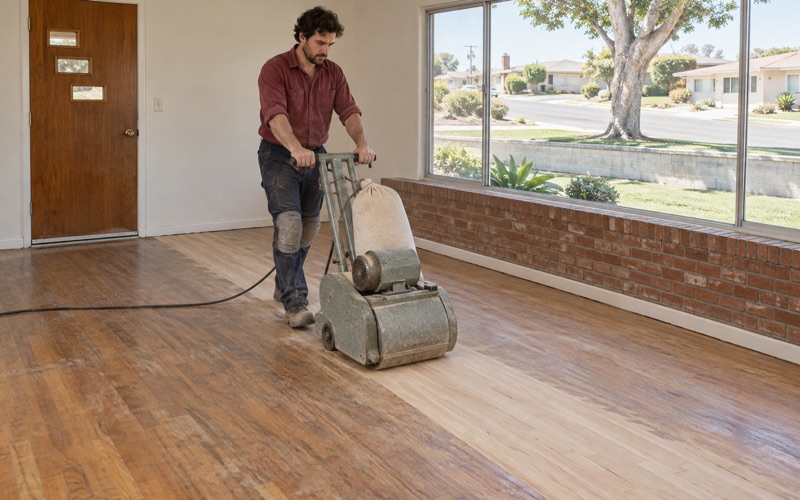
A floor laid in the 1970s or 1980s may be solid red oak strip, a parquet pattern that was popular at the time, or a floor that was carpeted from day one and has never had wood on it. Each of those leads to a different conversation. Strip oak often has enough thickness left for a full sand, while parquet needs a gentler approach with an orbital sander so the small blocks do not chatter or tear loose.
When we find the original floor intact, we look for cupping, crowning, hollow spots and squeaks before we promise a result. Forty or fifty years of foot traffic, furniture and the occasional water loss leave marks that a new coat of finish will not hide, and it is better to name them in the quote than to discover them halfway through a sand.
Build year and the lead-safe rule
The survey counts a large share of Rose Hills homes built in the 1970s, and anything completed before 1978 falls under the federal EPA Renovation, Repair and Painting Rule when painted surfaces are disturbed. Baseboards, shoe molding and old finish layers along the edges are where that matters for a floor job, since an edger works right against them.
So we confirm the build year before any sanding goes on the calendar. If the house predates 1978, the containment, dust control and cleanup are planned from the start rather than added once the drum sander is already in the room. For a house built in the 1980s the question is simpler, but we still ask, because a remodel can hide older materials under newer ones.
Finishes we can put down here
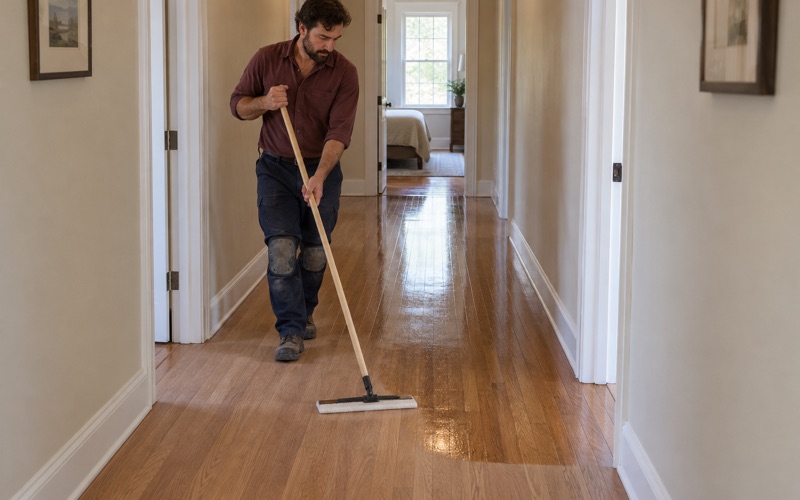
Whatever the age of the house, the finish has to be legal to apply in the South Coast air district, where the wood coatings VOC limit under SCAQMD Rule 1113 is 275 grams per liter. We choose waterborne polyurethane, compliant oil-modified products and hardwax oils from that list rather than from a national catalog, and we explain the tradeoffs in color, sheen level and recoat window.
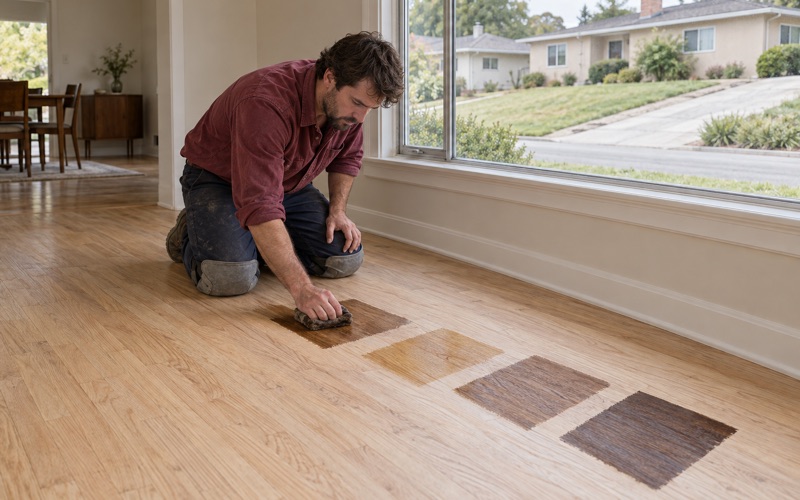
Stain is tested on sanded boards in the room itself before the whole floor is committed. Light in a hillside house can shift a lot between morning and late afternoon, and a sample that looked warm on a showroom card can read gray or orange once it is down on red oak in the actual living room.
Looking for wood-flooring closer to El Monte? See Wood-Flooring Services in El Monte.
Owner-Occupied Houses and Condo Units
The same survey reports 86.6 percent of occupied Rose Hills homes as owner-occupied. It also counts 144 owner households, about 16.5 percent of owners, living in buildings of five or more units. Most owners here are in detached houses, but a real share of them own a unit inside a larger building, and that changes what a floor job involves.
Working inside a condominium building
Floor work in a condo unit is governed by the association’s own documents, and those documents vary from one building to the next. Before we quote an installation in a unit, we ask the owner to pull whatever the association has on file about flooring, underlayment and working hours, and we build the job around what it says rather than around an assumption.
Upper-floor units raise the question of sound traveling to the neighbor below. Where a building calls for it, we pair the floor with an acoustic underlayment and a glue-down or floating installation suited to it, and we leave the rating question to the association’s documents and the product literature rather than quoting numbers of our own.
Spyglass Villas and buildings like it
Listing records describe Spyglass Villas, at 4512 Workman Mill Road, as a three-story, 100-unit condominium building completed in 1988. That makes it a good example of the kind of owner-held unit the survey is counting, and of the kind of floor we are often asked to replace: a late-1980s installation or an early replacement that has reached the end of its life.
In a building like that, logistics matter as much as the wood. Elevators, stairwells, parking for a work van and quiet hours all shape the schedule, and we plan material deliveries and debris removal so the neighbors see as little of the job as possible.
Planning around an occupied home
An owner who lives in the house is rarely in a position to leave for two weeks. Our room-by-room schedule lets a family close off one part of the home at a time, with dates for when each room can take foot traffic in socks, when furniture can return, and when rugs can go back down after the finish has fully cured.
We also talk through dustless sanding, which cuts down on what drifts into the rest of the house, and about the smell and dry time of each finish option. That way the family chooses a product knowing what the next several days in the house will be like.
Replacing a Later Floor Rather Than Restoring an Original
The survey reports no Rose Hills homes built in 2000 or later. Most houses and units in the neighborhood have seen decades of use, and many have already had their original floor swapped out once. The floor we find is often a 1990s or 2000s replacement, and the question becomes whether to rework it or start over.
Judging an engineered floor before promising a sand
Engineered hardwood was a common replacement choice, and its top veneer decides everything. We measure the wear layer thickness before we promise a full sand, because a thin veneer can take a screen and recoat but will sand through to the core if it is pushed too hard. If the veneer will not take a sand, we say so and price a recoat or a replacement instead.
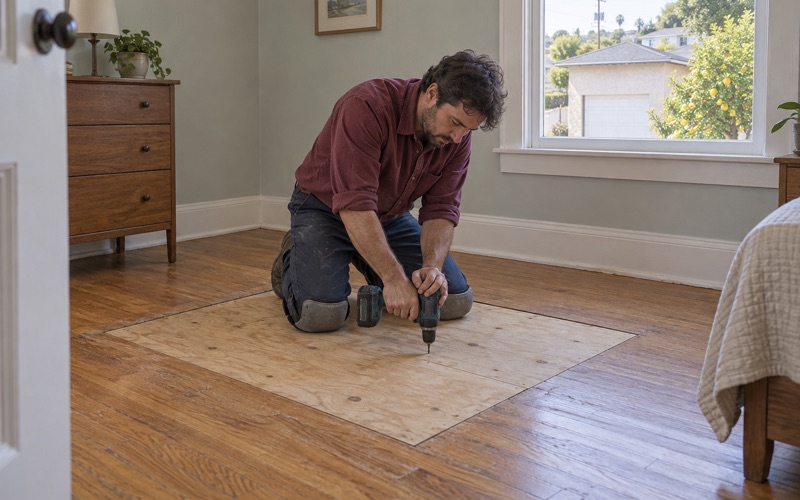
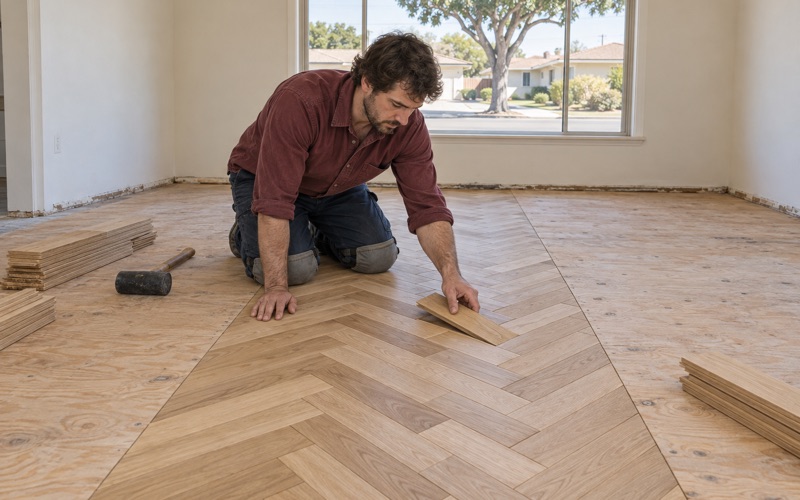
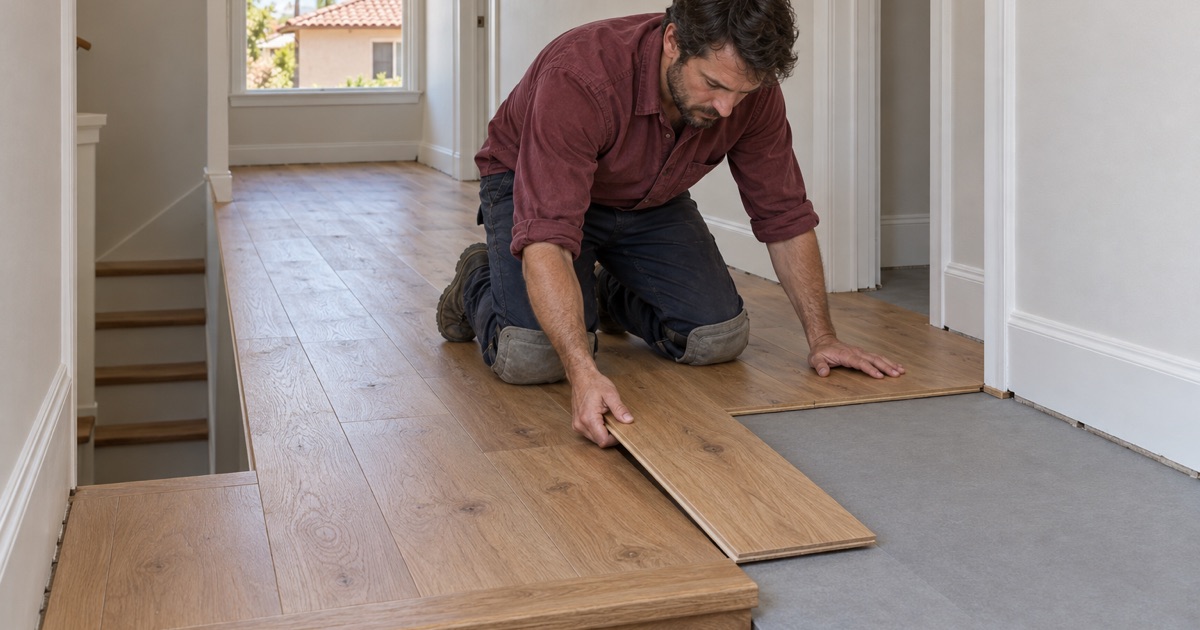
Laminate and luxury vinyl plank that went in during an earlier remodel cannot be refinished at all. When an owner wants real wood in their place, we pull the old product, check the subfloor for flatness and moisture, and discuss whether solid hardwood or engineered hardwood suits the room and the building better.
Damage that decides the scope
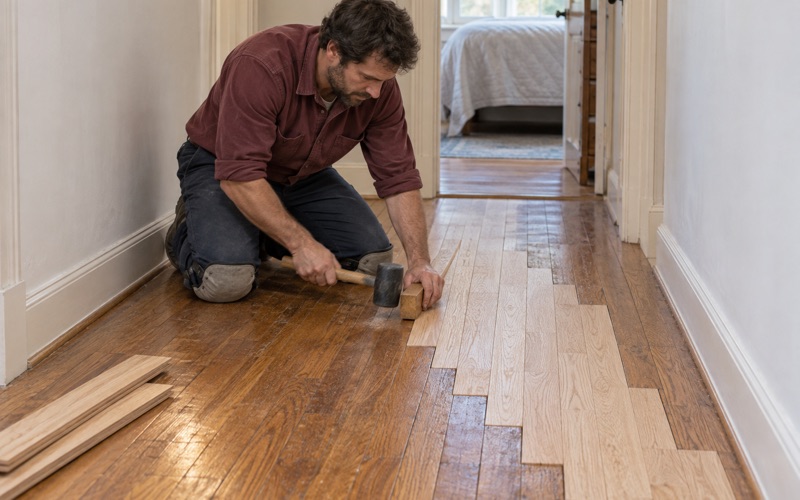
A later floor often carries its own history. Pet urine stains that have turned black, finish peeling in a high-traffic path, white haze from the wrong cleaning product, and cupping near a kitchen or bathroom all point to different repairs. Some can be handled with board replacement and a weave-in repair; others mean the floor has to come up.
Small round holes and fine pellet piles along a baseboard get a closer look before we touch a single board. They can be drywood termite kick-out holes and frass, and they need to be identified or ruled out first. Replacing boards over an active infestation just gives the termites fresh wood.
Water losses and insurance claims
When a floor is damaged by a supply-line break or a leak from the unit above, we document it with photos and moisture meter readings that an adjuster can actually use. The repair scope is written as matching board and matching finish across the affected area, since a patch that does not blend in rarely gives a reasonably uniform appearance.
That documentation also helps when the loss starts in a neighboring unit. In a building with shared walls and ceilings, a clear record of where the moisture was and when it was measured makes the conversation between owners and associations much easier.
Los Angeles County Rules and Rented Units
Rose Hills is a census-designated place made up mostly of the Spy Glass Hill section of unincorporated Whittier. It shares a Whittier mailing address, but it has no city government of its own, and the City of Whittier is not the building authority. Building work here answers to Los Angeles County Public Works, Building and Safety, under Title 26 of the county code.
What the county authority means for a floor job
Title 26 is now the 2026 County of Los Angeles Building Code, effective January 1, 2026, and it folds county amendments into the state and model codes. Public Works serves unincorporated communities through its headquarters and ten district offices. For owners, the practical point is simply to look to the county, not the city on the envelope, with any question about what their project needs.
We do not give permit answers for refinishing or replacement. Scope varies from one job to the next, and an owner who wants a firm answer should get it from County Building and Safety for the specific work planned. What we can do is describe the work in plain terms so that conversation goes quickly.
Rented Rose Hills condos and houses
About 13.4 percent of occupied homes here are rented, and most of those renters live in buildings of five or more units. Los Angeles County’s Rent Stabilization and Tenant Protections Ordinance covers most rental units in unincorporated areas, including single-family homes and condos, with a certificate of occupancy issued on or before February 1, 1995, unless exempt. Given the neighborhood’s build years, many rented units may fall inside that window, and coverage can be checked by address on the County Rent Registry.
For landlords, we write itemized invoices that separate the work done by room and by task. That makes it straightforward to attach them to a security deposit itemized statement when a tenant moves out, and it keeps the record clear if a question about normal wear versus damage comes up later.
- 20+ Years on Wood Floors
- Itemized Written Quotes
- Lead-Safe Checks on Pre-1978 Homes