Monterey Park Wood Flooring has handled wood flooring in Signal Hill for more than 20 years, and much of what we are asked to do here is care for floors that are still fairly young. Homeowners call us about a first recoat, a scratched hallway, a board lifted by a leak, or a repair that has to blend with a product the store no longer carries.
That work calls for a different mindset than restoring a worn century-old floor. A younger floor usually has plenty of life left in it, and the goal is to protect that life rather than spend it. We look at what the finish is doing, how much wood sits above the tongue, and whether a lighter service will carry the floor for years before a full sand is ever needed.
We still sand, stain and refinish older solid hardwood, rebuild stairs and replace damaged boards across the city. On every job we start by measuring and testing, then write the plan down room by room so you know when furniture, rugs and family can come back. The sections below explain how that plays out on the hill.
Wood Floors in Signal Hill’s Newer Homes
A city that kept building
Census figures show how much of the housing here is recent. Of Signal Hill’s 4,811 housing units, 997 were built in 2000 or later, which works out to 20.7 percent of the stock. That is a meaningful share of homes whose floors have seen one or two decades of wear at most, and whose owners are now meeting their first real round of floor maintenance.
The 2000s were the busiest stretch of that period. The American Community Survey counts 708 units built between 2000 and 2009, another 277 from 2010 to 2019, and 12 from 2020 onward. A floor put down in 2005 is roughly twenty years old now, which is the age when traffic lanes turn dull, finish wears through at doorways and the first serious scratches start to show.
From oil derricks to new housing on the hill
The newer homes sit on ground with a long industrial past. Oil was struck at Alamitos Well No. 1 on June 23, 1921, the hill was soon covered with derricks, and residents voted to incorporate in 1924. Production carried the local economy for decades until declining prices cut it back in the 1970s, and the city formed its redevelopment agency in 1974.
Signal Hill is its own city, a 2.2-square-mile enclave completely surrounded by the city of Long Beach, with the hill itself rising 365 feet above the land around it. The Alamitos No. 1 site is now California Historical Landmark No. 580. For our purposes the history explains the housing mix: land once given over to oil production opened up over time, and a good part of it became homes.
Looking for wood-flooring closer to Los Alamitos? See Wood-Flooring in Los Alamitos.
Caring for a Floor That Is Still Young
The first screen and recoat
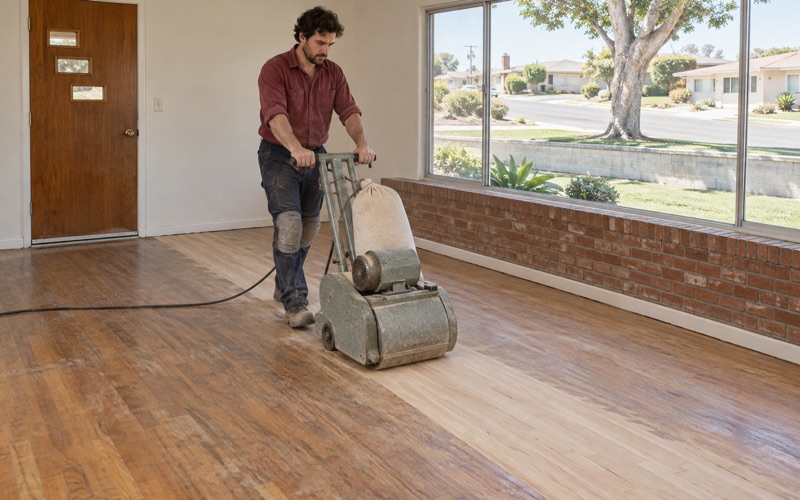
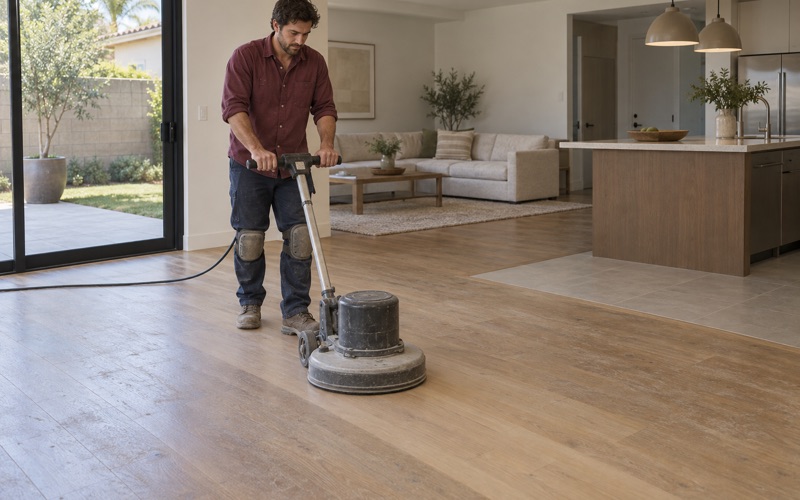
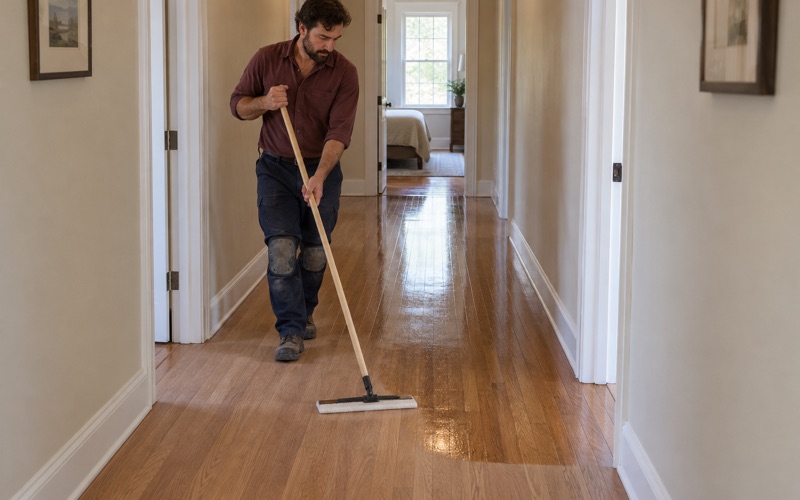
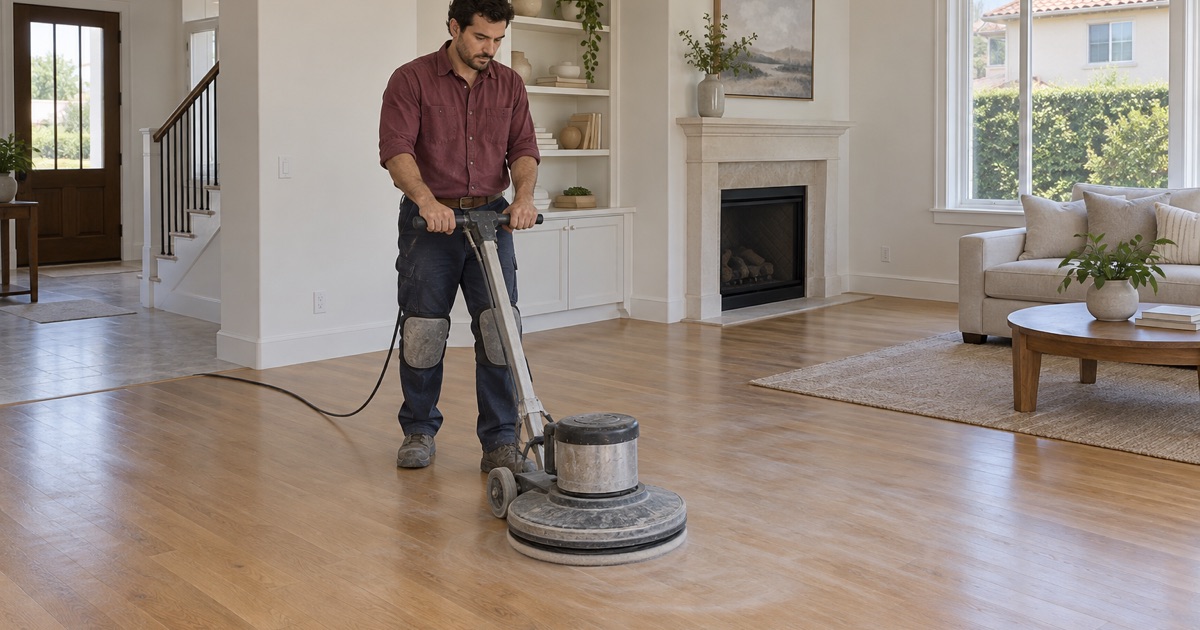
When a floor under twenty-five years old looks tired, the wood is rarely the problem. Usually the top coat has worn thin in traffic lanes while the rest of the finish is intact. A screen and recoat abrades the existing finish lightly and bonds a fresh coat to it, restoring protection without removing any wood, which matters on a floor you expect to keep for decades.
We confirm the floor will accept a recoat before promising one. Some factory finishes and maintenance polishes resist adhesion, and a coat laid over them can peel within weeks. We test a small area first and check for waxes or cleaning residue. If the finish has worn through to bare wood in places, a recoat alone will not fix it, and we tell you so plainly.
Scratches, pet damage and dull patches
Many calls from newer homes involve surface damage rather than wear. Pet claws, dragged chairs and grit carried in on shoes leave scratches that sit in the finish, not the wood, and those usually disappear under a recoat. Deeper gouges that reach bare wood may need spot sanding and a blended repair, or replacement of the damaged board if the dent is severe.
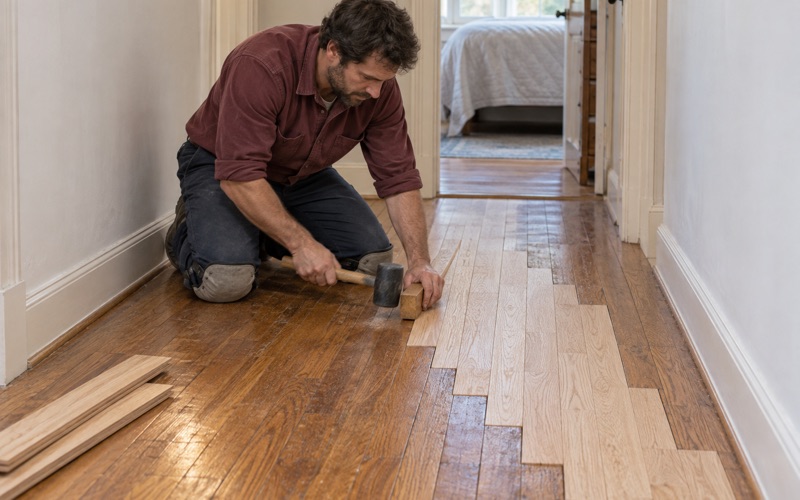
Pet urine stain is a different matter. Once urine soaks past the finish it can darken the fibers, and a black water stain from a long-standing leak behaves the same way. Neither sands out reliably, so we plan for board replacement and a weave-in repair instead of promising a sanding result the wood cannot deliver. White haze in the finish is often trapped moisture and can sometimes be treated.
Choosing a finish that is legal to use here
Signal Hill falls within the South Coast Air Quality Management District, and SCAQMD Rule 1113 limits the volatile organic content of wood coatings to 275 grams per liter. We choose finishes from products that meet that limit rather than from a national catalog, so what goes on your floor is legal to apply in this district and compatible with the coat underneath it.
Within those limits there are real choices to make. Waterborne polyurethane dries clear and cures quickly, oil-modified polyurethane adds warmth, and hardwax oil gives a low-sheen look that is easy to spot-repair. We also discuss sheen level, since a matte or satin finish hides fine scratches far better than gloss. Your schedule then follows each product’s recoat window and cure time.
Repairing and Matching Recent Flooring in Signal Hill
Water damage in a newer home
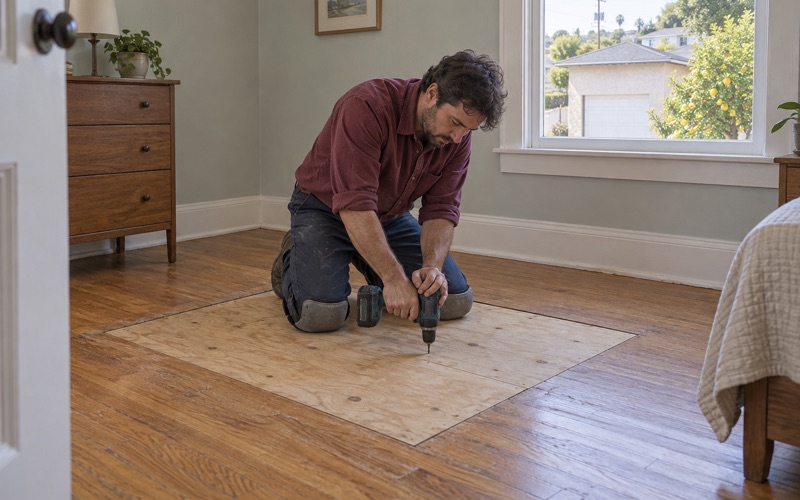
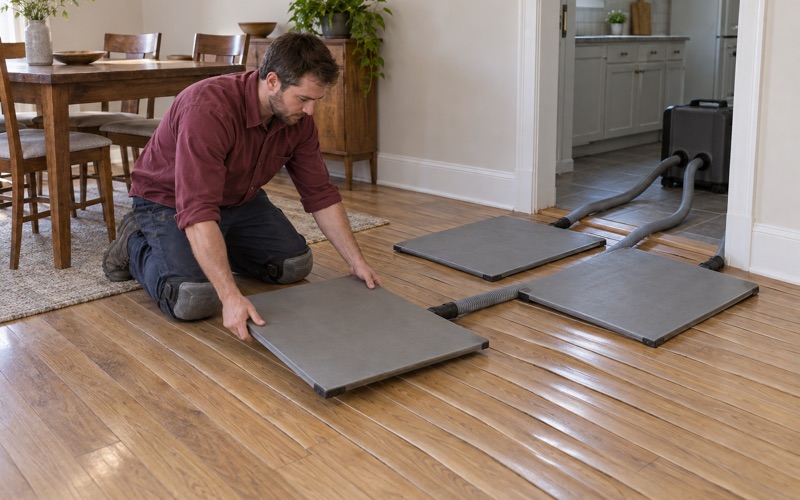
A slow dishwasher leak or a failed supply line can soak a floor before anyone notices. Cupping appears as board edges rise, crowning can follow if the floor is sanded too soon, and buckling means the boards have lifted off the subfloor. We take moisture meter readings across the affected area and beyond it, so the repair covers everything that absorbed water.
If an insurance claim is involved, we document the loss with photographs and moisture readings an adjuster can use. We write the scope as matching board and matching finish rather than a patch, because a repair that stands out from the surrounding floor is not a finished repair. Where possible we let the floor dry to its normal relative humidity before we cut anything out.
When the original product is discontinued
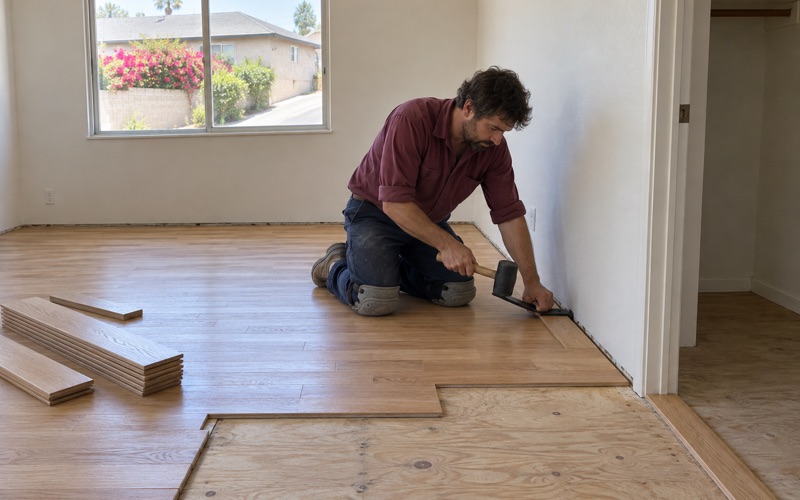
Matching is where younger floors get difficult. Many prefinished and engineered products installed in the 2000s have since been discontinued, and a new board labeled with the same species and color rarely matches after years of light exposure. We compare species, width, edge profile, thickness and the sheen of the factory finish before we recommend a replacement board.
When no close match exists, we have other options. Boards can sometimes be salvaged from a closet or the space under a built-in and moved into the damaged area, with the new material placed where it will not be seen. In other cases a room can be sanded and finished as a unit so the repair blends, instead of chasing an exact match that cannot be bought anymore.
Measuring the wear layer before promising a sand
If your floor turns out to be engineered hardwood, the thickness of its top veneer decides what it can take. A thick wear layer can be sanded, often more than once, while a thin one can take a screen and recoat but not a full sand. We measure the wear layer at a floor vent or an edge before quoting any sanding work.
That measurement protects the floor. A sand-through on a thin veneer exposes the plywood core underneath, and that damage cannot be refinished away, only replaced. So we would rather tell you that a recoat is the right service, or that a small area needs new boards, than promise a sanding result that the floor’s own construction rules out from the start.
Older Houses From Before 1960 on the Same Hill
Confirming the build year first
Not every home here is young. About 24.3 percent of Signal Hill’s housing units were built before 1960, and 353 date from 1939 or earlier. In those homes we confirm the build year before any sanding is scheduled, because paint and finish layers in pre-1978 housing are handled under the federal EPA Renovation, Repair and Painting Rule.
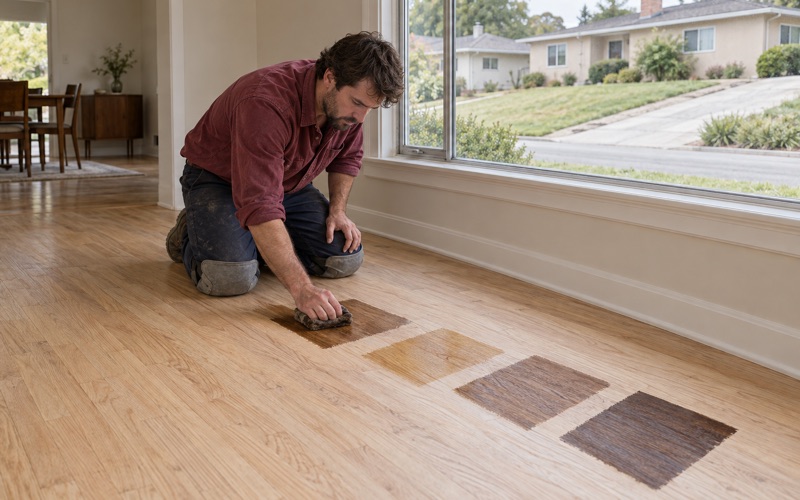
Older solid hardwood can often take a full sand and refinish, and red oak and white oak from those decades usually come back well. We work through an abrasive grit sequence with the drum sander, edger and orbital sander, taking care to avoid drum marks and chatter marks. Before staining the whole floor, we test color on sanded boards in the room’s own light.
Checking what lies beneath older floors
Older floors bring structural questions that newer ones rarely raise. If a house sits over a crawl space and the floor slopes, bounces or has a soft spot, we check from underneath before quoting, because a joist, post or subfloor problem is one that sanding would only hide. Sometimes the fix is a sister joist or a repaired subfloor rather than more finish work.
We also look for small round holes and piles of pellets before replacing boards. Those can be drywood termite kick-out holes and termite frass, or they can be something else entirely. We identify or rule out that evidence first, so any board we replace is replaced for the right reason, and squeaks or hollow spots are traced to their actual cause rather than guessed at.
Stairs, rentals and occupied homes
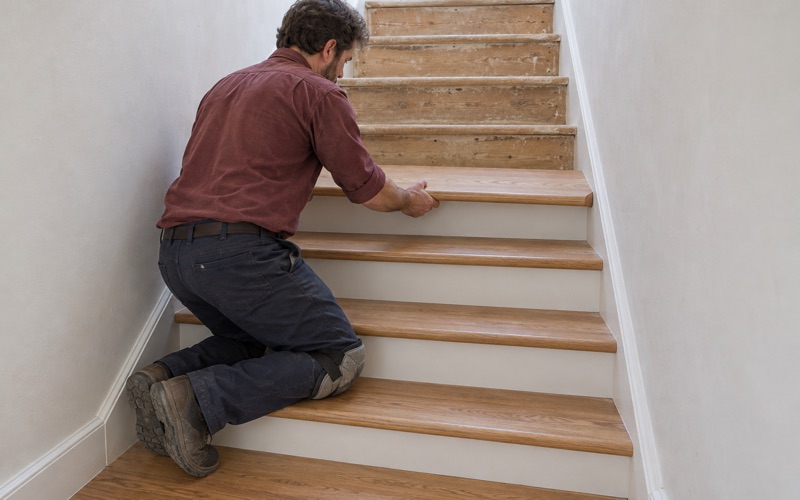
Homeowners and renters are almost evenly split in Signal Hill, at 50.3 percent owners and 49.7 percent renters. For landlords we write itemized invoices that can be attached to a security deposit statement, with each repair listed separately. For stairs we quote by the tread, riser and nosing rather than folding them into a square-foot price, so the cost reflects the work.
Most of our clients live in the home while the work happens. We give you a written schedule, room by room, that shows when each area will be sanded, finished and ready for light foot traffic, when rugs can go back down, and when heavier furniture can return. That way you can plan around the cure time instead of guessing at it.
- 20+ Years on Wood Floors
- Itemized Written Quotes
- Lead-Safe Checks on Pre-1978 Homes